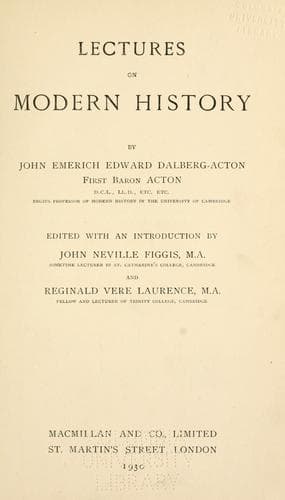
Lectures on Modern historyActon, John Emerich Edward Dalberg Acton, Baron
History
Lectures on Modern history
Acton, John Emerich Edward Dalberg Acton, Baron
History, Modern
I would point to three things in particular, out of many, which
constitute the amended order. Of the incessant deluge of new and
unsuspected matter I need say little. For some years, the secret
archives of the papacy were accessible at Paris; but the time was
not ripe, and almost the only man whom they availed was the
archivist himself #57. Towards 1830 the documentary studies began on
a large scale, Austria leading the way. Michelet, who claims,
towards 1836, to have been the pioneer #58, was preceded by such
rivals as Mackintosh, Bucholtz, and Mignet. A new and more
productive period began thirty years later, when the war of 1859
laid open the spoils of Italy. Every country in succession has
now been allowed the exploration of its records, and there is
more fear of drowning than of drought. The result has been that
a lifetime spent in the largest collection of printed books would
not suffice to train a real master of modern history. After he
had turned from literature to sources, from Burner to Pocock,
from Macaulay to Madame Campana, from Thiers to the interminable
correspondence of the Bonapartes, he would still feel instant
need of inquiry at Venice or Naples, in the Ossuna library or at
the Hermitage #59.
These matters do not now concern us. For our purpose, the main thing
to learn is not the art of accumulating material, but the sublimer art
of investigating it, of discerning truth from falsehood and certainty
from doubt. It is by solidity of criticism more than by the plenitude
of erudition, that the study of history strengthens, and straightens,
and extends the mind #60. And the accession of the critic in the place
of the indefatigable compiler, of the artist in coloured narrative,
the skilled limner of character, the persuasive advocate of good, or
other, causes, amounts to a transfer of government, to a change of
dynasty, in the historic realm. For the critic is one who, when he
lights on an interesting statement, begins by suspecting it. He
remains in suspense until he has subjected his authority to three
operations. First, he asks whether he has read the passage as the
author wrote it. For the transcriber, and the editor, and the
official or officious censor on the top of the editor, have played
strange tricks, and have much to answer for. And if they are not to
blame, it may turn out that the author wrote his book twice over, that
you can discover the first jet, the progressive variations, things
added, and things struck out. Next is the question where the writer
got his information. If from a previous writer, it can be
ascertained, and the inquiry has to be repeated. If from unpublished
papers, they must be traced, and when the fountain-head is reached, or
the track disappears, the question of veracity arises. The
responsible writer's character, his position, antecedents, and
probable motives have to be examined into; and this is what, in a
different and adapted sense of the word, may be called the higher
Public-domain text, read in full here on John Shaqi.
Reviews
Reviews
No reviews yet
Be the first to share your thoughts on this work.
Join the Discussion
Join the discussion
Sign in to leave a comment or review.
Sign InorCreate an account