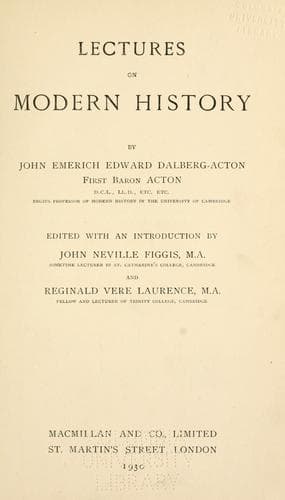
Lectures on Modern historyActon, John Emerich Edward Dalberg Acton, Baron
History
Lectures on Modern history
Acton, John Emerich Edward Dalberg Acton, Baron
History, Modern
Having given up the Pope, the government had no ground for keeping the
religious orders. They did not belong to the primitive Church, and
some of them, Grey Friars and Black Friars, were an essential part of
the medieval system which was rejected with the papal authority. When
Rome was taken in 1527, and Clement a prisoner, Wolsey, with some
other cardinals, proposed that he should act as his vicar during
captivity, so that the Church should not be receiving orders from the
Emperor through the Pope. This proposal is a first glimpse of what
was now introduced. The idea of a middle course, between Rome and
Wittemberg, occurred easily to every constant reader of Erasmus; and
many divines of the fifteenth century suggested something similar.
What then prevailed was not a theological view, but a political view.
The sovereignty of the Modern State, uncontrolled by the opinions of
men, commanded the minds both of Cromwell and of Gardiner, rivals
though they were. Cromwell is the first public man known to have been
a student of Machiavelli's writings; and the first to denounce them
was his enemy, Reginald Pole. It is the advent of a new polity.
Gardiner believed in it, thinking that nothing else could save
Catholicism after the mismanagement of the Church in Germany. And it
is the dominant note of the following years, whichever party was
prevailing.
That is the broad distinction between the continental Reformation and
the contemporary event in England. The one was the strongest
religious movement in the history of Christendom; the other was borne
onward on the crest of a wave not less overwhelming, the state that
admits no division of power. Therefore, when the spirit of foreign
Protestantism caught the English people they moved on lines distinct
from those fixed by the Tudors; and the reply of the seventeenth
century to the sixteenth was not a development, but a reaction.
Whereas Henry could exclude, or impose, or change religion at will
with various aid from the gibbet, the block, or the stake, there were
some among the Puritans who enforced, though they did not discover,
the contrary principle, that a man's conscience is his castle, with
kings and parliaments at a respectful distance.
VII
PHILIP II, MARY STUART, AND ELIZABETH
THE MONARCHY of Philip II was held by no binding idea, but religious
unity. The dynasty was new, and the king was not personally imposing or
attractive. The people of Palermo, Milan, Antwerp, had no motive to
make sacrifices, except the fact that their king was the one upholder
of religion in Europe. Catholics in every country were his natural
allies.
Public-domain text, read in full here on John Shaqi.
Reviews
Reviews
No reviews yet
Be the first to share your thoughts on this work.
Elsewhere in the archive
Join the Discussion
Join the discussion
Sign in to leave a comment or review.
Sign InorCreate an account