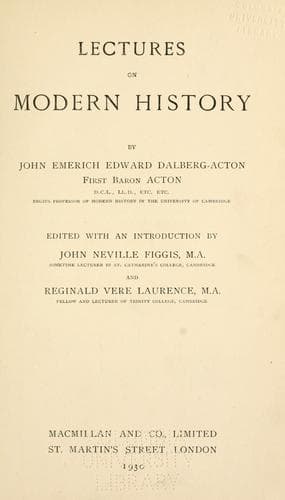
Lectures on Modern historyActon, John Emerich Edward Dalberg Acton, Baron
History
Lectures on Modern history
Acton, John Emerich Edward Dalberg Acton, Baron
History, Modern
Charles V, who accepted inevitable divisions in Germany, had
established the Inquisition in the Netherlands. Under Philip that
policy was consistent, and promised, in the flood of the
Counter-Reformation, to be a source of power. He would not fall behind
his father. He drove the Netherlands into rebellion; but his
intention was intelligible. In the sixteenth century the pride of
state does as much for oppression and intolerance as religious
passion. If he succeeded in repressing heresy, he would have a very
real political advantage over other powers. In October 1565 he wrote:
"As to the Inquisition, my will is that it be enforced by the
Inquisitors as of old, and as is required by all law, human and
divine. This lies very near my heart, and I require you to carry out
my orders. Let all prisoners be put to death, and suffer them no
longer to escape through the neglect, weakness, and bad faith of the
judges. If any are too timid to execute the edicts, I will replace
them by men who have more heart and zeal."
By this scheme of violence Philip II turned the Reformation into
revolution. He saw that generally nothing was more striking than the
ease with which people changed religious profession; and he believed
that what was done with success in Germany and Austria and England,
could be done in the seven provinces of the Burgundian crown. The
leaders of the popular movement were men of rank, like Egmont and
William of Orange, men not likely to go to extremes. And it was an
axiom that the masses are always led by few, and cannot act of
themselves. But in the Netherlands more than elsewhere the forms, if
not the reality, of freedom were preserved, and the sovereign was not
absolute. Moreover, he governed from a distance, and, in addition to
his constitutional caution and procrastination, correspondence was
very slow.
Public-domain text, read in full here on John Shaqi.
Reviews
Reviews
No reviews yet
Be the first to share your thoughts on this work.
Elsewhere in the archive
Join the Discussion
Join the discussion
Sign in to leave a comment or review.
Sign InorCreate an account