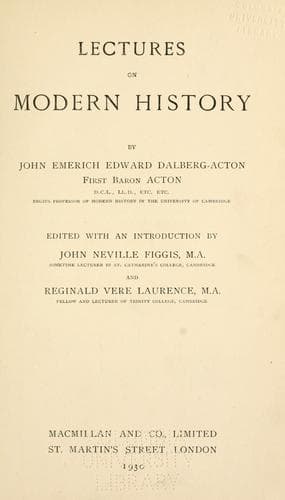
Lectures on Modern historyActon, John Emerich Edward Dalberg Acton, Baron
History
Lectures on Modern history
Acton, John Emerich Edward Dalberg Acton, Baron
History, Modern
The endeavour of Philip to substitute his will for self-government
provoked a Catholic and aristocratic opposition, followed by a
democratic and Protestant movement, which proved more difficult to
deal with. The nobles were overcome by the strong measures of Alva.
The Gueux were defeated by Don Juan and Farnese, after the recall of
Alva. And it seemed, for many years, that the movement would fail.
It is to the statesmanship of William the Silent, who was neither a
great soldier nor a strong churchman, that they owed their success.
He failed, indeed, to keep Protestants and Catholics together on a
wide basis of toleration. In 1579 the southern provinces returned to
Spain, and the northern provinces cast off their allegiance. But, by
the union of Utrecht, they founded that confederacy which became one
of the foremost powers in the world, and the first of revolutionary
origin. The southern provinces remained Catholic. The northern were,
in great measure, Protestant, but with a large Catholic population.
William, the Stadtholder, was killed by an assassin in 1584, before
his work was done. He had brought in Alencon, Elizabeth's suitor,
that he might secure the help of France. But Alencon proved a
traitor; and during the proconsulate of Farnese, Duke of Parma, the
Spaniards gained much ground.
Philip II stood at the height of his power in the middle of the
eighties. He had annexed Portugal, with its immense colonial empire.
By the death of Alencon, the King of Navarre, who was a Huguenot,
became the heir to the crown of France, and the Catholic party looked
to Spain for their salvation. Now, after many patient years, he
prepared for war with England. For Drake was ravaging Spanish
territory; and an English army under Leicester, having occupied the
Netherlands after the death of William, though they accomplished
little, gave just cause for an open quarrel. Whenever, in the course
of the Counter-Reformation, it came to a duel between Spain and
England, the fate of Protestantism would be staked on the issue. That
conflict was finally brought about, not by the revolt of the
Netherlands, but by the most tragic of all histories, that begins at
Holyrood with the murder of Riccio and ends twenty-one years later at
Fotheringay.
Public-domain text, read in full here on John Shaqi.
Reviews
Reviews
No reviews yet
Be the first to share your thoughts on this work.
Elsewhere in the archive
Join the Discussion
Join the discussion
Sign in to leave a comment or review.
Sign InorCreate an account