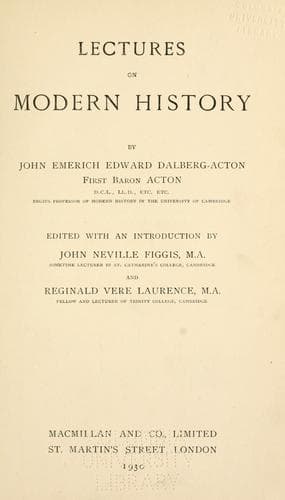
Lectures on Modern historyActon, John Emerich Edward Dalberg Acton, Baron
History
Lectures on Modern history
Acton, John Emerich Edward Dalberg Acton, Baron
History, Modern
When Mary Stuart came to Scotland the country had just become
Protestant. She did not interfere with the settlement, but refused to
permit the suppression of Catholicism, and became, in opposition to
the most violent of the reformers, a champion of religious
toleration. John Knox differed from all the Protestant founders in his
desire that the Catholics should be exterminated, root and branch,
either by the ministry of State, or by the self-help of all Christian
men. Calvin, in his letter to Somerset, went very far in the same
direction, but not so far as this. The nobles, or rather the heads of
clans, in whom the power of society resided, having secured the Church
lands, were not so zealous as their preachers, and the queen succeeded
in detaching them. Mary was religious without ferocity, and did not
share the passions of her time. She would have been willing to marry
Leicester, and to make herself dependent on English policy, but
Elizabeth refused to acknowledge her right of succession, and drove
her to seek connection with the Catholic Powers. She wished at one
time to marry Don Carlos, that, having been Queen of France, she might
become Queen of Spain. This was impossible; and so she became the wife
of Darnley, who united the blood of the Tudors and the Stuarts. She
belonged, on her mother's side, to the house of Guise, whose princes
were leaders of the militant Counter-Reformation. The duke, who had
slaughtered the Huguenots at Vassy, was now dead. But his brother, the
Cardinal, who afterwards claimed the merit of a more signal massacre,
was still an important personage in Church and State. Mary, appearing
on this background of sanguinary uncles, was believed to be an
adherent of their policy, and to take part in all extremes of the
Catholic reaction.
Riccio, the Piedmontese secretary, through whom she corresponded with
foreign princes, was hated accordingly; and Darnley, who attributed to
the Italian's influence his own exclusion from power, consented that
he should be made away with. The accomplices who wrought the deed
took care that Mary should know that they acted with his approval;
and when she found herself the wife of an assassin and a coward, the
breach ensued which was sometimes dissembled but never repaired.
Three months later their son was born, but Darnley was not present at
the christening. His enemies advised the Queen to obtain a divorce,
but she objected that it would injure the prospects of her son.
Maitland then hinted that there might be other ways of getting rid of
him. Mary did not yield consent; but the idea once started was
followed up, and the king was doomed to death by what was called the
Bond of Craigmillar.
Public-domain text, read in full here on John Shaqi.
Reviews
Reviews
No reviews yet
Be the first to share your thoughts on this work.
Elsewhere in the archive
Join the Discussion
Join the discussion
Sign in to leave a comment or review.
Sign InorCreate an account