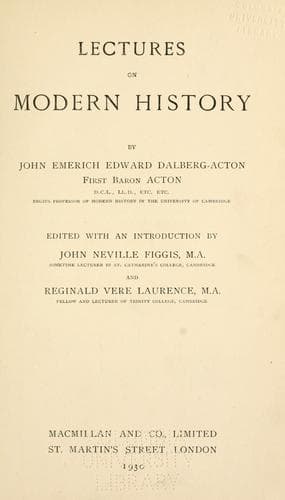
Lectures on Modern historyActon, John Emerich Edward Dalberg Acton, Baron
History
Lectures on Modern history
Acton, John Emerich Edward Dalberg Acton, Baron
History, Modern
At the end of 1566 he fell seriously ill at his father's house at
Glasgow. Mary came, spent three days with him, and an explanation
took place, amounting apparently to a reconciliation. Darnley was
taken to Edinburgh, and lodged about a mile from Holyrood, at
Kirk-o'-Field, where he was repeatedly visited by the queen. On the
night of 9th February she went away to attend a ball, and three hours
after she had left him his house was blown up, and he was found in the
garden, strangled. Nobody doubted at the time, or has ever doubted
since, that the crime was committed by the Earl of Bothwell, a rough
and resolute soldier, whose ambition taught him to seek fortune as a
supporter of the throne. He filled Edinburgh with his troops, stood
his trial, and was at once acquitted. Thereupon his friends, and some
who were not his friends, acting under pressure, resolved that he
should marry the queen. As a widow, she was helpless. Bothwell
possessed the energy which Darnley wanted, and, as he was a
Protestant, the queen would be less isolated. He had killed her
husband; but then her husband was himself a murderer, who deserved his
fate. Bothwell, encouraged by many of the Lords, had only executed
justice on a contemptible criminal. There was a debt of gratitude
owing to him for what he had done.
Public decorum forbade that the queen should ostensibly accept the
offer of a man who made her a widow ten weeks before. Therefore
Bothwell waylaid the queen at the Brig of Almond, some miles from
Edinburgh, dispersed her attendants, and carried her off to Dunbar.
There was a difficulty about the marriage, because he was married
already. He now procured a divorce, and, ten days after the outrage
at Almond Brig, they reappeared at Edinburgh. The queen publicly
forgave Bothwell for what he had done, made him a duke, and, on 15th
May, three months after the explosion at Kirk-o'-Field, married him
according to the Presbyterian rite. The significant sequence of these
events gave an irresistible advantage to her enemies. It was an
obvious inference that she had been a party to the murder of the king,
when she was so eager to marry the man that slew him. The only answer
would be by discarding him. Nobody could think the son safe in the
hands of his father's murderer.
Either the Lords must get the queen into their power, or they must
dethrone her and govern Scotland during the long minority of her son.
The forces met at Carberry Hill. There was no fight. Mary hoped, by
a temporary parting from her third husband, to save her crown. She
passed into captivity, was shut up at Loch Leven, and compelled to
abdicate. The Protestant interest was at last supreme.
Mary escaped from her island prison, gathered an army, gave battle at
Langside, and lost it, and then, losing courage before her cause was
helpless, fled to England, in the belief that Elizabeth would save
her.
Public-domain text, read in full here on John Shaqi.
Reviews
Reviews
No reviews yet
Be the first to share your thoughts on this work.
Elsewhere in the archive
Join the Discussion
Join the discussion
Sign in to leave a comment or review.
Sign InorCreate an account