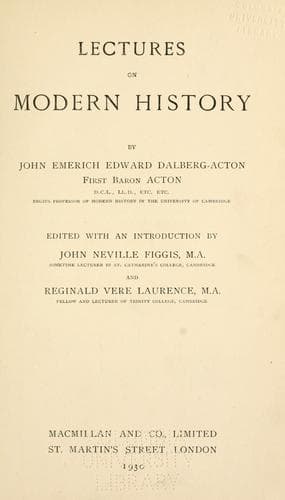
Lectures on Modern historyActon, John Emerich Edward Dalberg Acton, Baron
History
Lectures on Modern history
Acton, John Emerich Edward Dalberg Acton, Baron
History, Modern
From the death of Darnley, still more after her Protestant marriage,
she had ceased to be the champion of her own Church. That was again
her position when she came to England. There, she was heir to the
throne, and the centre of all the hopes and efforts to preserve or to
restore Catholicism.
The story of Mary Stuart cannot be told without an understanding in
regard to the Casket Letters. They are still the object of an
incessant controversy, and the problem, although it has made progress
of late, and the interest increases with the increase of daylight,
remains unsolved. The view to be taken of the events depends
essentially on the question of authenticity. If the letters are what
they seem to be, the letters of the queen to Bothwell, then she is
implicated in the murder of her husband. If they are not authentic,
then there is no evidence of her guilt. Everybody must satisfy
himself on this point before he can understand the ruin of the
Catholic cause in Scotland and in England, and the consequent arrest of
the Counter-Reformation in Europe.
At the same time the issue does not seriously affect the judgment of
History on the character of the queen herself. She repeatedly
expressed her delight in murder, and her gratitude to those who
executed or attempted it, and stands on the same level of morality
with the queen her mother-in-law, or with the queen her rival. But the
general estimate does not throw light on the particular action, and
supplies no help in a hanging matter.
The opinion of historians inclines, on the whole, in her favour.
About fifty writers have considered the original evidences
sufficiently to form something like an independent conclusion.
Eighteen of these condemn Mary, thirty pronounce her not guilty; two
cannot make up their minds. Most of the Catholics absolve, and among
Protestants there is an equal number for and against. The greater
names are on the hostile side. They do not carry weight with us,
because they decided upon evidence less complete than that which we
possess. Four of the greatest, Robertson, Ranke, Burton, Froude, were
all misled by the same damaging mistake. The equal division of the
Protestants shows how little any religious bias has had to do with the
inquiry; so that the overwhelming majority on the Catholic side
requires explanation.
Public-domain text, read in full here on John Shaqi.
Reviews
Reviews
No reviews yet
Be the first to share your thoughts on this work.
Elsewhere in the archive
Join the Discussion
Join the discussion
Sign in to leave a comment or review.
Sign InorCreate an account