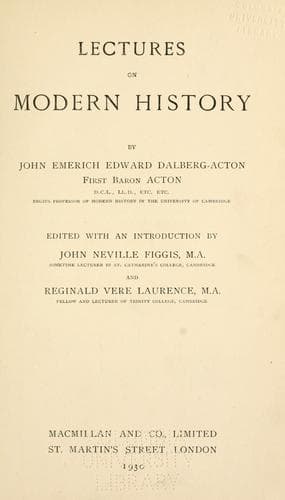
Lectures on Modern historyActon, John Emerich Edward Dalberg Acton, Baron
History
Lectures on Modern history
Acton, John Emerich Edward Dalberg Acton, Baron
History, Modern
There have been two reasons for it. Many found it difficult to
understand how a woman who died so edifying a death could have been a
murderess. It would be easy to find many instances of men in that age
who led holy lives and died with sincerity, but who, in the matter of
homicide, had much in common with the Roman triumvirs, or the heroes
of the French Revolution. But persons disposed to admit that
difficulty would naturally be impressed by an argument of much greater
force. The man who produced the famous letters, the Chancellor
Morton, was a notorious villain. He had kept guard at Holyrood while
his friends slew Riccio. Further, many have admitted, many more are
now ready to admit, that some portion of the letters is forged. In
that case, how can we accept evidence which the forgers have supplied?
How can we send Mary to the scaffold on the testimony of perjured
witnesses? Either we must say that the proofs are genuine throughout,
and that Morton did not suffer them to be tampered with, or we must
absolve Mary. Nobody, I think, at the present day, will deny that the
letters, as we have them, were tampered with. Therefore we must hold
Mary to be not guilty. Everybody can see the force of this argument,
and the likelihood that it would impress those who expect to find
consistency in the lives and characters of men, or even of women.
On 20th June, 1567 Morton captured Dalgleish, one of Bothwell's men,
who had helped to kill Darnley. In order to escape torture--he did not
escape capital punishment--Dalgleish delivered up a silver gilt casket
which had belonged to the queen's first husband, and which now
contained papers, the property of her third husband. Among them were
eight letters, not directed, or dated, or signed, but which were
recognised by those who saw them to be in the handwriting of the
queen.
Towards the end of July it began to be whispered, by Moray in London,
by Throckmorton at Edinburgh, that they proved her complicity in the
death of Darnley, and justified the Lords in deposing her. In the
following year, when Mary had sought a refuge in England, these papers
were produced, and they furnished the argument by which Elizabeth
justified the detention of the Scottish queen. The decisive piece is a
long document, known as the Glasgow letter, which alludes distinctly
to the intended crime. As it contains a conversation with Darnley,
which he repeated to Crawford, one of his officers, the confirmation
thus supplied caused it to be widely accepted at the time, and by the
four writers I named just now.
Public-domain text, read in full here on John Shaqi.
Reviews
Reviews
No reviews yet
Be the first to share your thoughts on this work.
Elsewhere in the archive
Join the Discussion
Join the discussion
Sign in to leave a comment or review.
Sign InorCreate an account