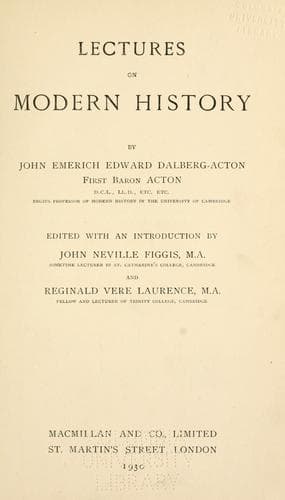
Lectures on Modern historyActon, John Emerich Edward Dalberg Acton, Baron
History
Lectures on Modern history
Acton, John Emerich Edward Dalberg Acton, Baron
History, Modern
That is what puts them out of court; for the letter was evidently
concocted by men who had Crawford's report before them. The letter is
spurious, and it is the only one that connects the queen with the
death of Darnley. It does not follow that the others are spurious,
for they add nothing to the case. The forgers, having constructed the
damning piece, would not be likely to do more. Every additional
forgery would increase the risk of detection, without any purpose.
What purported to be the originals do not exist. They can be traced
down to 1584, and no farther. The handwriting can no longer be
tested. Until lately, the French text of the letters was not known,
and they could be studied only in translations.
Since 1872, when the Hatfield letters were discovered, and were
printed at Brussels, we possess four in their original shape. These
cannot be seriously impeached. The comparison of the style and
language with that of Mary's undisputed writings shows that they
correspond; and they do not resemble in the same degree those of her
contemporaries. The ablest of Mary's advocates accept these letters as
genuine. But they deny that they were written to Bothwell. The writer
speaks of a secret marriage, which she would like to disclose. There
certainly was no secret marriage with Bothwell; but it is a possible
hypothesis that she may have married Darnley in secret before the
ceremonial wedding. Therefore this letter, which is a love letter, is
quite legitimate, and is meant for the right address. But the word
which the queen uses, marriage, is employed in the sense of a wedding
ring, as they say alliance or union, to this day, in the same
meaning. She is regretting that she must wear the ring round her neck,
and cannot produce it in public, because of Darnley.
Besides the one which is spurious and the four which are genuine,
there are three other letters which we do not know in the original
French. They cannot be tested in the same manner as those I have just
spoken of, and cannot be accepted with the same confidence. If, then,
we divide the letters in this way: one evidently forged, four
evidently genuine, and three that are best left aside, the result is
that there is no evidence of murderous intent. But it would appear
that Mary wished to be carried off by Bothwell, and that she meant to
marry him. How she proposed to dispose of her living husband, whether
by death or by his consent to divorce, we cannot tell. The case is
highly suspicious and compromising; but more than that is required for
a verdict of guilty in a matter of life and death.
Public-domain text, read in full here on John Shaqi.
Reviews
Reviews
No reviews yet
Be the first to share your thoughts on this work.
Elsewhere in the archive
Join the Discussion
Join the discussion
Sign in to leave a comment or review.
Sign InorCreate an account