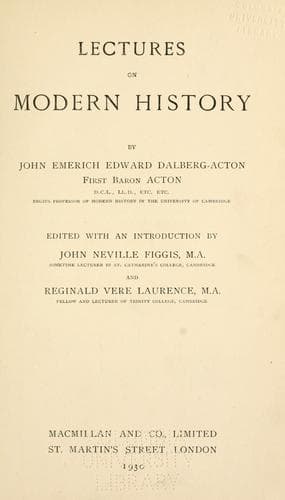
Lectures on Modern historyActon, John Emerich Edward Dalberg Acton, Baron
History
Lectures on Modern history
Acton, John Emerich Edward Dalberg Acton, Baron
History, Modern
What is known as the Penal Laws begins with Mary's captivity in
England. There was the northern rising; the Pope issued a Bull
deposing Elizabeth, and Philip undertook to make away with her; for
the Queen of Scots, once Queen of France, now fixed her hopes on Spain
and the forces of the Counter-Reformation. The era of persecution
began which threw England back for generations, while France, Germany,
Austria, the Netherlands were striving for religious freedom. It was
proposed to extirpate the Catholics. Negotiations were opened with
the Scots to give them back their queen, on condition that they would
at once put her to death. And when she had been condemned for
plotting treason, Elizabeth asked her gaoler to murder her in her
prison. The execution at Fotheringay gave Elizabeth that security at
home which she could never have enjoyed while Mary lived. But it was
the signal of danger from abroad. Philip II was already preparing for
war with England when Mary bequeathed her rights to him. The legal
force of the instrument was not great, but it gave him a claim to
fight for, constituting the greatest enterprise of the Reformation
struggle. Sixtus V, the ablest of the modern Popes, encouraged him.
Personally, he much preferred Elizabeth to Philip, and he offered her
favourable terms. But he gave his benediction, and even his money, to
the Spaniards when there was a chance that they would succeed. And
their chances, in the summer of 1588, seemed very good. The Armada
was stronger, though not much stronger, than the English fleet; but
the army that was to be landed at the mouth of the Thames was
immeasurably superior to the English. This was so evident that Philip
was dazzled and listened to no advice. They might have sailed for
Cork and made Ireland a Spanish stronghold. They might have supplied
Farnese with the land force that he required to complete the conquest
of the revolted provinces, putting off to the following year the
invasion of England. When they came in sight of Plymouth, Recalde,
one of the victors of Lepanto, and Oquendo, whose name lasted as long
as the Spanish navy, for the ship of the line that bore it was sunk in
Cervera's action, demanded to fight. But the orders were peremptory
to sail for Dunkirk and to transport Farnese to Margate. The Armada
made the best of its way to Gravelines, where they were attacked
before Farnese could embark, and the expedition failed.
Public-domain text, read in full here on John Shaqi.
Reviews
Reviews
No reviews yet
Be the first to share your thoughts on this work.
Elsewhere in the archive
Join the Discussion
Join the discussion
Sign in to leave a comment or review.
Sign InorCreate an account