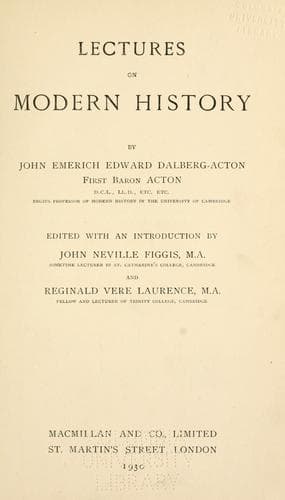
Lectures on Modern historyActon, John Emerich Edward Dalberg Acton, Baron
History
Lectures on Modern history
Acton, John Emerich Edward Dalberg Acton, Baron
History, Modern
An American writer, meditating upon our history at Battle, on the spot
where Harold fell, once expressed his thought in these words, "Well,
well, it is a small island, and has been often conquered." It was not
conquered in August 1588, because Drake held the narrow seas. The
credit was not shared by the army. And it may be a happy fortune that
the belated levies of Tilbury, commanded by Leicester, never saw the
flash of Farnese's guns. For the superiority of Spain was not by sea,
nor the greatness of England on land. But England thenceforth was
safe, and had Scotland in tow. Elizabeth occupied a position for
which her timorous and penurious policy, during so many years, had not
prepared the world. She proposed terms to Philip. She would
interfere no more in the Low Countries, if he would grant toleration.
Farnese entered into the scheme, but Philip refused. The lesson of
the Armada was wasted upon him. He did not perceive that he had lost
Holland as well as England.
The revolt of the Netherlands created a great maritime power; for it
was by water, by the dexterous use of harbours, estuaries, and dykes,
that they obtained independence. By their sea power they acquired the
trade of the Far East, and conquered the Portuguese possessions. They
made their universities the seat of original learning and original
thinking, and their towns were the centre of the European press. The
later Renaissance, which achieved by monuments of solid work what
dilettantism had begun and interrupted in the Medicean age, was due to
them and to the refuge they provided for persecuted scholars. Their
government, imperfect and awkward in its forms, became the most
intelligent of the European governments. It gave the right of
citizenship to revolutionary principles, and handed on the torch when
the turn of England came. There the sects were reared which made this
country free; and there the expedition was fitted out, and the king
provided, by which the Whigs acquired their predominance. England,
America, France have been the most powerful agents of political
progress; but they were preceded by the Dutch. For it was by them
that the great transition was made, that religious change became
political change, that the Revolution was evolved from the
Reformation.
VIII
THE HUGUENOTS AND THE LEAGUE
WHEN THE religious frontiers were fixed in the rest of Europe, in
France, the most important state of all, they were still unsettled.
There the struggle was obstinate and sanguinary, and lasted more than
thirty years, ending, towards the close of the century, with the
triumph of the Crown over the nation, and the State over the Church.
Public-domain text, read in full here on John Shaqi.
Reviews
Reviews
No reviews yet
Be the first to share your thoughts on this work.
Elsewhere in the archive
Join the Discussion
Join the discussion
Sign in to leave a comment or review.
Sign InorCreate an account