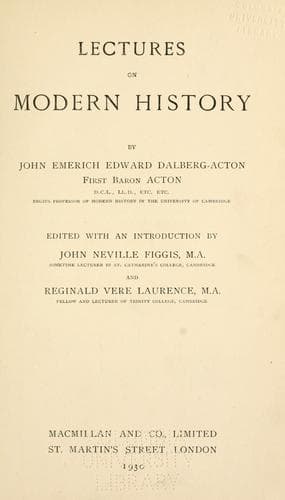
Lectures on Modern historyActon, John Emerich Edward Dalberg Acton, Baron
History
Lectures on Modern history
Acton, John Emerich Edward Dalberg Acton, Baron
History, Modern
Although the French had had at least one reformer before the
Reformation, and were prepared by the Gallican system for much
divergence from prevailing forms of medieval Catholicism; they
received the new ideas as an importation from Germany. In that shape,
as Lutheranism, they never became an important force in the country,
though there was, a time of comparative toleration, followed, after
1535, by the severities which at that time became usual in Europe.
The number of victims in the last years of Francis I is supposed to
have been eighty-five or a little more. Luther, in his life and
thought, presented so many characteristics of the exclusively German
type as to repel the French, who, during many years of that
generation, were at war with Germany. After his death, the first man
among the reformers was a Frenchman, and the system as he recast it
was more congenial. Calvinism possessed the important faculty of
self-government, whilst Lutheranism required to be sustained by the
civil power. For these reasons the Calvinistic doctrines obtained a
far more favourable hearing, and it is in that shape only that the
Reformation struck root in France.
King Henry II, who had been educated in Spain, where he was detained
as a hostage, was resolutely intolerant, and when the general peace
was concluded he turned his thoughts to the state of religion. He
made an attempt to introduce the Inquisition, but was killed in a
tourney before he had achieved his purpose. The Protestants at that
time were estimated by Calvin at about 300,000, and in certain
districts they were increasing rapidly. They had two translations of
the Bible, and a celebrated book of hymns; and they now began to
combine and organise. They were strongest in Dauphiny, which was near
Geneva, and at Lyons, which was a centre of trade. Then they spread
to Normandy, and in the west, and as time went by it became difficult
to say which part of the country or which class of the population was
most deeply influenced by their doctrine. No province ever became
Protestant, and hardly any town. There never was any prospect that
the Reformation would prevail; but at first, in the tide of early
expansion, this was not quite evident, and they dreamt, not of liberty
only, but of predominance. They did not profess the liberal
principle, and never repudiated the maxim of their chief at Geneva
regarding the repression of other sects. They thought it a life and
death struggle, persuaded that the Catholics were irreconcilable, and
impossible fellow-subjects and neighbours. By image-breaking,
assaults on processions, and general violence, they made the part of
tolerant Catholics difficult to play. As a religious body, guided by
the counsels of Calvin, they should have professed passive obedience.
But they were associated with vast political interests, and with men
less eager about points of doctrine than about affairs of state, who
brought them into action against the government. As there were
Public-domain text, read in full here on John Shaqi.
Reviews
Reviews
No reviews yet
Be the first to share your thoughts on this work.
Elsewhere in the archive
Join the Discussion
Join the discussion
Sign in to leave a comment or review.
Sign InorCreate an account