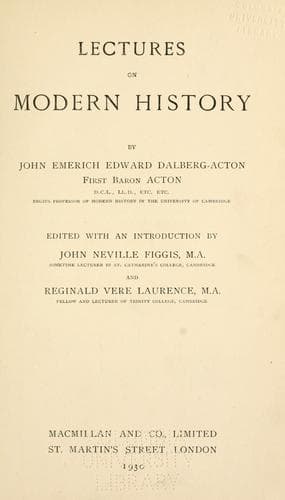
Lectures on Modern historyActon, John Emerich Edward Dalberg Acton, Baron
History
Lectures on Modern history
Acton, John Emerich Edward Dalberg Acton, Baron
History, Modern
I speak of this school with reverence, for the good it has done, by
the assertion of historic truth and of its legitimate authority over
the minds of men. It provides a discipline which every one of us does
well to undergo, and perhaps also well to relinquish. For it is not
the whole truth. Lanfrey's essay on Carnot, Chuquet's wars of the
Revolution, Ropes's military histories, Roget's Geneva in the time of
Calvin, will supply you with examples of a more robust impartiality
than I have described. Renan calls it the luxury of an opulent and
aristocratic society, doomed to vanish in an age of fierce and sordid
striving. In our universities it has a magnificent and appointed
refuge; and to serve its cause, which is sacred, because it is the
cause of truth and honour, we may import a profitable lesson from the
highly unscientific region of public life. There a man does not take
long to find out that he is opposed by some who are abler and better
than himself. And, in order to understand the cosmic force and the
true connection of ideas, it is a source of power, and an excellent
school of principle, not to rest until, by excluding the fallacies,
the prejudices, the exaggerations which perpetual contention and the
consequent precautions breed, we have made out for our opponents a
stronger and more impressive case than they present themselves #65.
Excepting one to which we are coming before I release you, there is
no precept less faithfully observed by historians.
Ranke is the representative of the age which instituted the
modern study of History. He taught it to be critical, to be
colourless, and to be new. We meet him at every step, and he
has done more for us than any other man. There are stronger
books than any one of his, and some may have surpassed him in
political, religious, philosophic insight, in vividness of the
creative imagination, in originality, elevation, and depth of
thought; but by the extent of important work well executed, by
his influence on able men, and by the amount of knowledge which
mankind receives and employs with the stamp of his mind upon it,
he stands without a rival. I saw him last in 1877, when he was
feeble, sunken, and almost blind, and scarcely able to read or
write. He uttered his farewell with kindly emotion, and I feared
that the next I should hear of him would be the news of his
death. Two years later he began a Universal History, which is
not without traces of weakness, but which, composed after the age
of 83, and carried, in seventeen volumes, far into the Middle
Ages, brings to a close the most astonishing career in literature.
Public-domain text, read in full here on John Shaqi.
Reviews
Reviews
No reviews yet
Be the first to share your thoughts on this work.
Join the Discussion
Join the discussion
Sign in to leave a comment or review.
Sign InorCreate an account