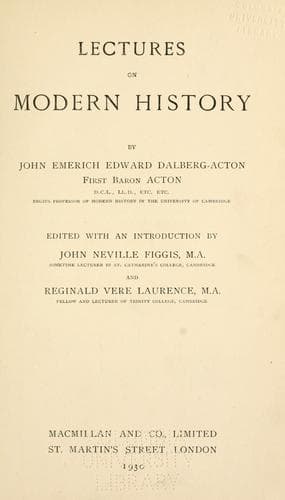
Lectures on Modern historyActon, John Emerich Edward Dalberg Acton, Baron
History
Lectures on Modern history
Acton, John Emerich Edward Dalberg Acton, Baron
History, Modern
His course had been determined, in early life, by Quentin
Durward. The shock of the discovery that Scott's Lewis the
Eleventh was inconsistent with the original in Commynes made him
resolve that his object thenceforth should be above all things to
follow, without swerving, and in stern subordination and
surrender, the lead of his authorities. He decided effectually
to repress the poet, the patriot, the religious or political
partisan, to sustain no cause, to banish himself from his books,
and to write nothing that would gratify his own feelings or
disclose his private convictions #66. When a strenuous divine, who,
like him, had written on the Reformation, hailed him as a
comrade, Ranke repelled his advances. "You," he said, "are in the
first place a Christian: I am in the first place a historian.
There is a gulf between us." #67 He was the first eminent writer who
exhibited what Michelet calls _le desinteressement des morts_. It
was a moral triumph for him when he could refrain from judging,
show that much might be said on both sides, and leave the rest to
Providence #68. He would have felt sympathy with the two famous
London physicians of our day, of whom it is told that they could
not make up their minds on a case and reported dubiously. The
head of the family insisted on a positive opinion. They answered
that they were unable to give one, but he might easily find fifty
doctors who could.
Niebuhr had pointed out that chroniclers who wrote before the
invention of printing generally copied one predecessor at a time,
and knew little about sifting or combining authorities. The
suggestion became luminous in Ranke's hands, and with his light
and dexterous touch he scrutinised and dissected the principal
historians, from Machiavelli to the _Memoires d'un Homme d'Etat_,
with a rigour never before applied to moderns. But whilst
Niebuhr dismissed the traditional story, replacing it with a
construction of his own, it was Ranke's mission to preserve, not
to undermine, and to set up masters whom, in their proper sphere,
he could obey. The many excellent dissertations in which he
displayed this art, though his successors in the next generation
matched his skill and did still more thorough work, are the best
introduction from which we can learn the technical process by
which within living memory the study of modern history has been
renewed. Ranke's contemporaries, weary of his neutrality and
suspense, and of the useful but subordinate work that was done by
beginners who borrowed his wand, thought that too much was made
of these obscure preliminaries which a man may accomplish for
himself, in the silence of his chamber, with less demand on the
attention of the public #69. That may be reasonable in men who are
practised in these fundamental technicalities. We, who have to
learn them, must immerse ourselves in the study of the great
examples.
Public-domain text, read in full here on John Shaqi.
Reviews
Reviews
No reviews yet
Be the first to share your thoughts on this work.
Join the Discussion
Join the discussion
Sign in to leave a comment or review.
Sign InorCreate an account