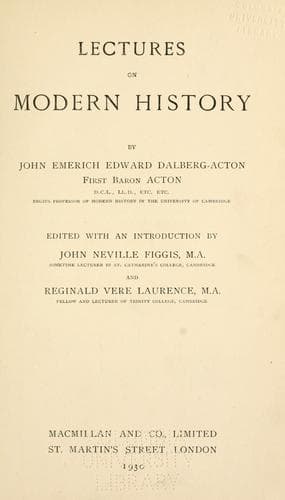
Lectures on Modern historyActon, John Emerich Edward Dalberg Acton, Baron
History
Lectures on Modern history
Acton, John Emerich Edward Dalberg Acton, Baron
History, Modern
We have no reliable statistics of the slain. The fugitives who
escaped to England spoke of one hundred thousand. At Rome they put
the figure for Paris alone at sixty thousand. For the capital a basis
of calculation is supplied by the number of bodies found in the river.
The result would be something over two thousand. In the provinces
there are reports from about forty towns. The Protestant martyrology
assigns two thousand to Orleans alone. But Toussaint, one of the
ministers, who was there, and had the good fortune to escape, knew
only of seven hundred, and that is still the belief in the town
itself. It was said that two hundred perished at Toulouse. But the
president, Durand, who lost some of his own friends, and whose Memoirs
were not written for the public, speaks of thirty-six. In five towns
the victims amounted to between one hundred and seven hundred. In all
the rest they were fewer. Taking the more authentic figures, and in
cases where we cannot decide between statements that conflict,
preferring the lower figure, because of the tendency to exaggerate
where there is passion or excitement, we arrive at rather more than
five thousand for the whole of France. The editor of Queen
Catharine's correspondence, La Ferriere, urged me to make some
allowance for persons who lost their lives on the byways in attempting
to escape. That is a probable conjecture, but no evidence takes us as
high as eight thousand. I reached that conclusion many years ago, and
it is confirmed by what has since appeared, especially by the new
Histoire Generale, which accepts the limit I have mentioned. The
higher estimates commonly given are not based on a critical
investigation. The character of the event, and of its authors and
admirers, is not affected by numbers. For the massacres of September
and the revolutionary tribunal wrought less bloodshed in twenty-three
months than the French Catholics had done in about as many days. At a
time when papal agents estimated the Huguenots at one-fifth of the
entire population, the loss of five thousand, or even of eight
thousand, would not seriously weaken them. It checked their increase,
and injured mainly the royalist element among them, for Coligny was
the leader of the party that desired to support the monarchy.
Public-domain text, read in full here on John Shaqi.
Reviews
Reviews
No reviews yet
Be the first to share your thoughts on this work.
Elsewhere in the archive
Join the Discussion
Join the discussion
Sign in to leave a comment or review.
Sign InorCreate an account