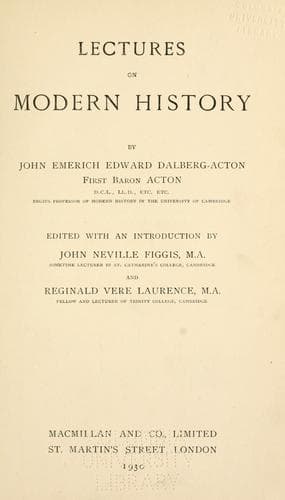
Lectures on Modern historyActon, John Emerich Edward Dalberg Acton, Baron
History
Lectures on Modern history
Acton, John Emerich Edward Dalberg Acton, Baron
History, Modern
Lord Clarendon has said that it was a massacre that all pious
Catholics, in the time in which it was committed, decried, abominated,
and detested. There were, of course, many in France who thought it
possible to be a good Christian without being a professional murderer,
and who sincerely desired toleration. For such men it was impossible
to continue associated with the Catholics of the League, and they were
in far closer sympathy with the Protestants. In this way a new party
arose, which was called the Politiques, and consisted of those whose
solicitude for dogma did not entirely silence the moral sense and the
voice of conscience, and who did not wish religious unity or
ascendency to be preserved by crime. It was on an ethical issue that
the separation took place, but it necessarily involved political
consequences of a definite kind.
The Politiques became promoters of the regal authority against the
aggression of the clergy, the aristocracy, and the democracy. They
had their strength among the jurists and the scholars in an age when
France was at the head of all scholarship and jurisprudence. The very
reason of their existence was the desire to resist the influence and
the spirit of Rome, and to govern France on contrary principles to
those professed by ecclesiastical authority and enforced by
ecclesiastical law. Therefore they strove to reduce the action of the
Papacy within very strictly defined limits, to abolish ultramontanism,
and to develop the Gallican theory of Church and State which French
divines had produced at the reforming councils of the fifteenth
century. As the clergy were subject to a Power which had encouraged
extermination, they aimed at the supremacy of the secular order, of
the lawyer over the priest, and of the State over the Church. They
were the most intelligent advocates of the modern state in relation to
society. For them, the representative of the State was the crown, and
they did their utmost to raise it above the restraining forces. For
the purpose that animated them the sole resource was the monarchy; and
it is they who terminated the wars of religion, the League, and the
Revolution, and prepared the great period of the Bourbon kings. Their
ideas survive, and are familiar to the later world in the classic
History of Thuanus.
Public-domain text, read in full here on John Shaqi.
Reviews
Reviews
No reviews yet
Be the first to share your thoughts on this work.
Elsewhere in the archive
Join the Discussion
Join the discussion
Sign in to leave a comment or review.
Sign InorCreate an account