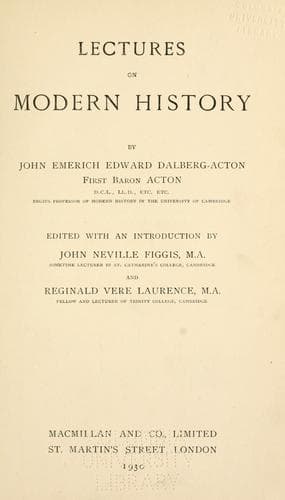
Lectures on Modern historyActon, John Emerich Edward Dalberg Acton, Baron
History
Lectures on Modern history
Acton, John Emerich Edward Dalberg Acton, Baron
History, Modern
The survivors closed their ranks and rapidly established a system of
self-government, which sought safety in its own organisation, not in
the protection of the crown. The intense conservatism of the early
Protestants was already giving way in the Netherlands, and it now made
way in France for the theory of resistance. A number of books
appeared, asserting the inalienable right of men to control the
authority by which they are governed, and more especially the right of
Frenchmen, just as, in the following century, Puritan writers claimed
a special prerogative in favour of Englishmen, as something distinct
from the rest of mankind. The most famous is the Vindiciae contra
Tyrannos, by Junius Brutus, generally attributed to Hubert Languet,
but written, as I believe, by Duplessis Mornay, a man eminent as a
party leader, who lost ground by entering on religious controversy.
As an adherent and even a friend of Henry of Navarre, he was moderate
in his language. This is the beginning of the literature of
revolution. But the Huguenots quickly restrained themselves, for the
same reason which, as we shall see, drove the Catholics of the League
to the extremity of violence and tyrannicide. The cause of these
dissimilar consequences was the problem of succession to the crown.
Henry III had no children, and the future of the Valois dynasty rested
on his only brother, the duke of Anjou, formerly of Alencon, the
favoured and apparent suitor of Elizabeth, who by his perfidy and
incompetence lost the government of the Netherlands.
In 1584 Anjou died, and nobody remained between the king and Henry of
Navarre, the head of the Bourbons. Therefore, if the king died, the
next heir would be the chief of the Protestants, a relapsed heretic,
whom the Pope had excommunicated. It would be the ruin of the
Catholics as a political party, and the renunciation of Catholicism as
a system of law and authority, for a relapsed heretic was a culprit to
whom the Church could show no mercy. To make him king was to defy the
ecclesiastical code, and to abandon the practice of Rome and Spain for
that of Germany under the Peace of Religion. The example of Denmark,
of Sweden, and of England showed that a Protestant king would impose
his religion on the people. They preferred to fight for the principle
that a people should impose its religion on the king. This
consideration was the origin of the League, as a great confederation
distinct from earlier and less important associations. It was
constituted out of three distinct elements: first, Guise and his
partisans, who had carried on the civil wars, and were the Catholic
portion of the aristocracy; then the Parisian democracy, who had acted
with the others against Coligny and the Huguenots, who cherished a
strong municipal spirit, and eventually created a supreme commune,
such as had existed in the fourteenth century, and was seen again in
1792 and in 1871; lastly, Philip II of Spain, who gave a million
crowns.
Public-domain text, read in full here on John Shaqi.
Reviews
Reviews
No reviews yet
Be the first to share your thoughts on this work.
Elsewhere in the archive
Join the Discussion
Join the discussion
Sign in to leave a comment or review.
Sign InorCreate an account