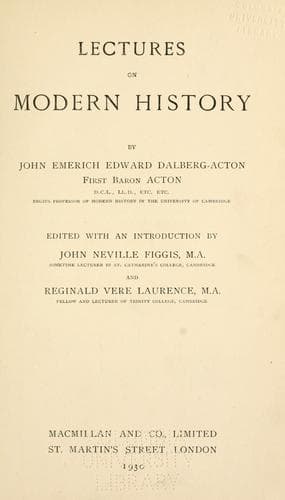
Lectures on Modern historyActon, John Emerich Edward Dalberg Acton, Baron
History
Lectures on Modern history
Acton, John Emerich Edward Dalberg Acton, Baron
History, Modern
Meantime, Henry III was supported in a half-hearted way by Protestants
and Politiques, who did not trust him, and Guise, at the head of the
population, made himself master of Paris. Henry retired to Blois.
After that outrage, refusing to acknowledge that the breach was
irremediable, the duke followed, and trusted himself, undefended, in
his enemy's hands. Then followed the only thing by which Henry III
could retain his power. He took six days to make up his mind that it
was right, and then ordered Guise to be dispatched. His brother, the
cardinal, met with the same fate. Catharine of Medici, who was in the
castle of Blois when this happened, and also had thirty years'
experience in such things, died immediately, after giving her son
warning that the merit is not in the way you cut the thread, but in
the way you sew it. He thought that he was safe at last, and the
applause of Europe followed him on his march against the capital. He
had shown so much weakness of will, such want of clearness and
resource, that nobody believed he had it in him. In the eyes of
Parisians he was guilty of the unpardonable sin, for he had killed the
popular leader and the champion of orthodoxy. As he was also an ally
of heretics and an accomplice of Navarre, a young Dominican came into
his camp and stabbed him. His name was Jacques Clement, and he became
a popular hero and martyr, and his example is cited by Mariana as the
true type of tyrannicide. The action of the crazy friar produced
effects that were not intended, for it made Henry of Navarre King of
France. A long struggle awaited him before he prevailed against the
League, the armed citizens of Paris, the Pope, and the King of Spain.
He succeeded by the support of the Royalists and Legitimists, who
detached themselves from the theological conflict, and built up an
independent ideal of political right.
IX
HENRY THE FOURTH AND RICHELIEU
THE ARGUMENT of the following half century, from the civil wars to the
death of Richeleau, as in the English parallel from the Armada to the
Long Parliament, was the rise of political absolutism. Henry IV, the
prince who made it acceptable and national, and even popular in
France, was fitted to disarm resistance, not only by brilliant
qualities as a soldier and a statesman, but also by a charm and
gladness of character in which he has hardly a rival among crowned
heads. He succeeded in appeasing a feud which had cost oceans of
blood, and in knitting together elements which had been in conflict
for thirty years. The longing for rest and safety grew strong, and
the general instinct awarded him all the power that was requisite to
restore public order and dominate surging factions.
Public-domain text, read in full here on John Shaqi.
Reviews
Reviews
No reviews yet
Be the first to share your thoughts on this work.
Elsewhere in the archive
Join the Discussion
Join the discussion
Sign in to leave a comment or review.
Sign InorCreate an account