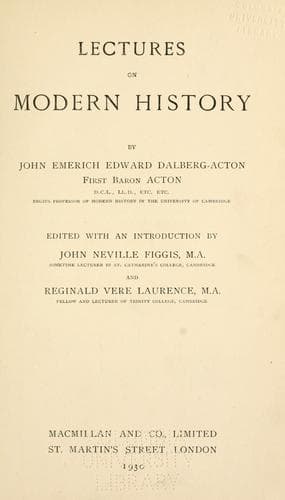
Lectures on Modern historyActon, John Emerich Edward Dalberg Acton, Baron
History
Lectures on Modern history
Acton, John Emerich Edward Dalberg Acton, Baron
History, Modern
The Catholics held out till 1594 at Paris, and still longer in Rome.
But the League began to go to pieces when its invincible protector,
Farnese, died in 1592. Then Mayenne, the general of the League, who
was a Guise, and his brothers successor as leader of the Catholic
nobility, came to a breach with the fierce democracy of Paris. The
siege, by intensifying antagonism and passions, had produced new
combinations in politics and a wider horizon. The Parisians who,
twenty years earlier, had adopted massacre as a judicious expedient,
now adopted revolution. The agitators and preachers who managed
opinion, taught the right of armed resistance, the supremacy of the
masses, the duty of cashiering kings, the lawfulness of tyrannicide.
The blending of inquisition with revolution was a novelty.
Since the popes had become temporal sovereigns, like the of the
Gentiles, the tendency of the Church was towards conservatism and
sympathy with authority. But the Parisian clergy, when opposing
monarchy associated 'with Protestantism, endeavoured to employ the
utmost violence of popular feeling. And they had the support of Rome.
A papal legate was shut up in the capital, encouraging it to resist.
He belonged to the ancient and illustrious house of Caetani. The last
head of that family, the father of the Duke of Sermoneta, lately
minister of foreign affairs, once showed me an inscription, in
monumental Latin, setting forth how he had at last paid off the
immense debt incurred by the legate in the defence of Paris. With
Caetani was Bellarmin, the most famous controversialist of the
sixteenth century, who there imbibed the doctrines which made him one
of the masters of revolutionary Catholicism, and a forerunner of
Algernon Sidney. There, too, Mariana had witnessed the scenes of
1572, and learnt the mingled lesson of conditional authority, revolt,
and murder, which he taught publicly, and without incurring censure at
Madrid or Rome. For thirty years these views prevailed over a wider
circle, and were enforced in many volumes too ponderous to survive.
Public-domain text, read in full here on John Shaqi.
Reviews
Reviews
No reviews yet
Be the first to share your thoughts on this work.
Elsewhere in the archive
Join the Discussion
Join the discussion
Sign in to leave a comment or review.
Sign InorCreate an account