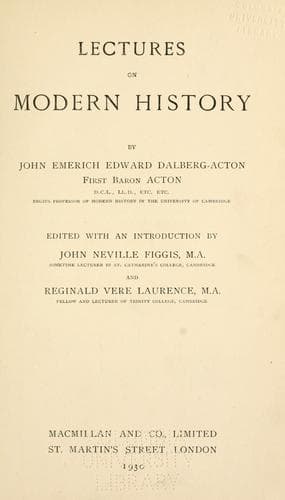
Lectures on Modern historyActon, John Emerich Edward Dalberg Acton, Baron
History
Lectures on Modern history
Acton, John Emerich Edward Dalberg Acton, Baron
History, Modern
In France the revival of these sanguinary sentiments served to
increase reaction and to strengthen the party of the throne. In
preference to such defenders of religion and the public good, people
turned to the austere Royalists and Gallicans. The change was not
final or complete, and did not carry all men with it. Imitators of
Jacques Clement arose among the clergy, and Henry fell at last by the
hand of a fanatic. When Mayenne sent the leaders of the populace to
the scaffold, the defence became hopeless. Henry foiled his enemies
by becoming a Catholic. He was not capable of taking dogmatic issues
much to heart, and never ceased to hope for reunion, believing that
the breach could be repaired, and that men who took pains to
understand each other would find that there was no insurmountable
obstacle to reconciliation. Many profited by the change who doubted
his sincerity. But Henry was in the hands of Duperron, one of the
most expert divines of modern times, who proved more than a match for
Duplessis Mornay, and whom Casaubon, a better scholar than Duplessis
Mornay, described as a thunderbolt of a man. Nobody supposed that he
would have conformed if it had involved the sacrifice of the crown.
It is not clear that it did actually involve the sacrifice of his
conviction. The Pope, under Spanish influence, hesitated long to
acknowledge him. It was a defeat and a humiliation to accept as
eldest son of the Church an excommunicated heretic, who, by the law of
the Supreme Tribunal, deserved to die, and to submit to him because he
was victorious over Catholics of France and Spain. His elevation was
a boon to the French, because he restored the prosperity of their
Church; but it was none to Rome, because his belief was a compromise
between Roman doctrine and ethics the reverse of Roman. The delicate
negotiation was carried to a satisfactory end by Cardinal D'Ossat,
whose despatches were long received, and perhaps still are, as the
best in the language, and the model of all diplomacy. Spain followed
Rome, and a conference was held under the presidency of the Pope,
which concluded peace in the Treaty of Vervins. Then Philip II died,
a defeated and disappointed man, whose schemes were wrecked by an
inflexible intolerance; but with his military power undiminished,
still the master of incomparable legions, still the ruler of the
greatest empire in History.
Public-domain text, read in full here on John Shaqi.
Reviews
Reviews
No reviews yet
Be the first to share your thoughts on this work.
Elsewhere in the archive
Join the Discussion
Join the discussion
Sign in to leave a comment or review.
Sign InorCreate an account