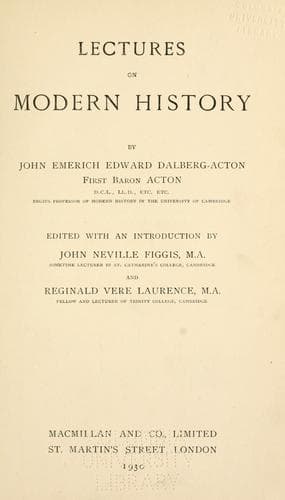
Lectures on Modern historyActon, John Emerich Edward Dalberg Acton, Baron
History
Lectures on Modern history
Acton, John Emerich Edward Dalberg Acton, Baron
History, Modern
Henry IV closed the era of religious wars by granting liberty to
Protestants on terms intended to ensure permanence. All offices,
civil and military, were thrown open; they retained their cities of
refuge, and acquired the machinery of equal justice, by the expedient
of mixed tribunals. The Catholics gained even more; for whereas
Protestant churches were excluded from Paris, and from certain towns
which had capitulated on that condition, the mass was restored
everywhere, and particularly in two hundred and fifty towns from which
the Huguenots, who predominated in the west and south, had banished
it.
The Edict of Nantes forms an epoch in the progress of toleration,
that is, in the history of liberty, which is the marrow of all modern
History. It is a more liberal scheme than the Peace of Religion,
which satisfied the previous generation of Germans. It pacified
France and afforded to the minority sufficient strength and safety,
not on the basis of religious equality, but in the shape of
circumscribed and definite privilege. Some of the Acts of
Pacification which failed had been more ample. Socinians went much
deeper in the sixteenth century, and Independents in the seventeenth.
The edict involved no declaration of new principles, and no surrender
of ancient claims. The government made concessions of a purely
practical kind, which might be revoked thereafter, if the Huguenots
became less formidable and the crown more powerful. There was no
recognition that they were concessions of the moral order, which it
would be usurpation to refuse, or to which the subject had a right
under a higher law. The action of the crown was restricted, without
detriment to its authority. No other religious body was admitted but
that which had made its power felt by arms in eight outbreaks of civil
war. Beyond them, persecution was still legitimate. The power of the
Protestants was acknowledged, not the prerogative of conscience. The
Edict of Nantes was not one of those philosophical instruments which
breed unending consequences, growing from age to age, and modifying
the future more and more. It was a settlement, not a development.
This was the method chosen in order to evade resentment on the part of
Catholics and the weakening of the crown. To speak in general or
abstract terms of the sovereign conscience was to urge the contrast
between the Roman Inquisition and the spirit of early Christianity,
and to promote a breach with the Catholicism of Southern Europe. To
proclaim that the civil magistrate has no right to regulate belief was
to limit monarchy and to repel the Politiques, who were the
legislators of the day, and who attributed all power on earth to the
State, admitting a wise restraint, but no renunciation of right.
Public-domain text, read in full here on John Shaqi.
Reviews
Reviews
No reviews yet
Be the first to share your thoughts on this work.
Elsewhere in the archive
Join the Discussion
Join the discussion
Sign in to leave a comment or review.
Sign InorCreate an account