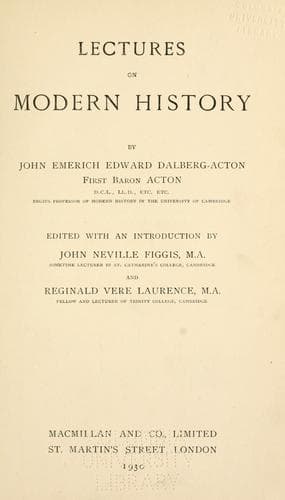
Lectures on Modern historyActon, John Emerich Edward Dalberg Acton, Baron
History
Lectures on Modern history
Acton, John Emerich Edward Dalberg Acton, Baron
History, Modern
The plan adopted achieved the desired result. The Protestants enjoyed
the faculty of self-government, and their great writers and scholars
were free to influence opinion by their writings. While the stubborn
fixity of German Lutherans and Swiss Calvinists lifted them out of the
stream of actual history, French Protestantism, like English, was full
of growth and originality. The law of the new government was to raise
the Crown above parties, and the State above the nation. It was part
of the doctrine which Machiavelli revealed to the men of the
Renaissance. The Middle Ages had practised class government. The
interests dominant in society dominated the State, and employed it for
their own advantage. The territorial aristocracy, or the clergy,
legislated for themselves and controlled taxation. Venice, which was
a republic not of landowners but of shipowners, was the first to
revert to the ancient notion of the State acting for its own purposes,
bound to no interest, following the opinion of no majority. Venice
turned from the sea to the land, and became an Italian Power, in
obedience to no class, on public grounds only, regardless of other
influences. The French monarchy, as Henry restored it, was of
necessity raised above the contending parties, and was the organ of no
inspiration but its own. He dropped the states-general, which had
been turbulent and hostile, and carried out his measures in defiance
of the parliaments. That of Rouen refused for ten years to register
the Edict of Nantes. Feeling safe with the Protestants and with the
Politiques, who were the real basis of his administration, he devoted
himself to the task of winning over their Catholic opponents. The
Jesuits represented Rome, the Counter-Reformation, and the League, and
were banished for tyrannicide. Henry recalled them, and made one of
them, a divine whose life has been written in four volumes, the keeper
of his conscience. He was solicitous of the friendship of Rome, and
of influence in the College of Cardinals, where his moderating hand
was soon felt.
Public-domain text, read in full here on John Shaqi.
Reviews
Reviews
No reviews yet
Be the first to share your thoughts on this work.
Elsewhere in the archive
Join the Discussion
Join the discussion
Sign in to leave a comment or review.
Sign InorCreate an account