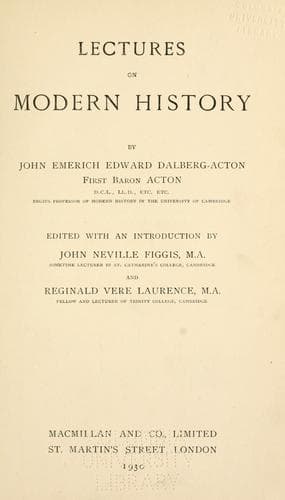
Lectures on Modern historyActon, John Emerich Edward Dalberg Acton, Baron
History
Lectures on Modern history
Acton, John Emerich Edward Dalberg Acton, Baron
History, Modern
The king's conciliatory policy triumphed in a quarrel which broke out
between Rome and Venice. The Papacy desired to enforce a system of
its own in matters of Church and State, and, in other words, to make
laws for the nations to obey. The Canon Law did not come down from
heaven, but was enacted from time to time in the past, and was to be
enacted furthermore in the future. Venice, as a modern state,
self-sufficing and concentrating power, legislated for its clergy as
well as for its laity, resenting interference outside questions of
pure doctrine. The two pretensions clashed under Paul V, a zealous
and uncompromising pontiff, the founder of the House of Borghese. He
claimed a jurisdiction in Venice which could not have been asserted
successfully in France or Spain, because a surrender of authority
which may be made to superior force cannot be made voluntarily where
there is no compulsion. But the court of Rome was the chief seat of
those aspirations after the control of states, which had been so
lately renewed.
Since the failure of the schemes against Elizabeth and the victory of
Gallicans over the League and the medieval ideal, a new heresy, the
political heresy, had been discovered, which Cardinal Baronius, the
foremost of the Roman divines, denounced as the most damnable of all
heresies. By that was meant the notion of a science of politics
limiting the ecclesiastical domain; an ethical and political system
deriving its principles elsewhere than from the Church, and setting up
a new and rival authority yet to be defined, ascertainable in no book,
and not accepted by the nations. Those amongst us who deny the
existence of a political science, and believe that ethics cannot be
made to include politics, have ardent supporters in the Roman clergy
of three centuries ago. The Venetian theorists who could be caught
were burnt at Rome. One, who did not trust himself in Roman hands,
was badly wounded near his own door. This was the famous Father Paul,
whose History of the Council of Trent issued from this controversy.
He was a Servite monk and theological adviser to the government, and
the emissaries who flocked from England, France, Geneva, and the
German states, to see how far the Venetians would move away from Rome,
believed that he was at heart a Calvinist. In reality Sarpi had more
of the eighteenth century than of the sixteenth in his turn of mind,
and stood far aloof from the doctrines over which his contemporaries
contended, and the expectations entertained of his countrymen were
illusory. The city was placed under an interdict, and the orders that
were faithful to Rome departed across the Lagoon, singing hymns. The
Pope looked about for means of coercion when Henry mediated. He owed
much to Venice, which was the first of the Catholic Powers to
recognise him. In action, he called to his men to watch where his
white plume waved, and to follow wherever they saw it. In gratitude
Public-domain text, read in full here on John Shaqi.
Reviews
Reviews
No reviews yet
Be the first to share your thoughts on this work.
Elsewhere in the archive
Join the Discussion
Join the discussion
Sign in to leave a comment or review.
Sign InorCreate an account