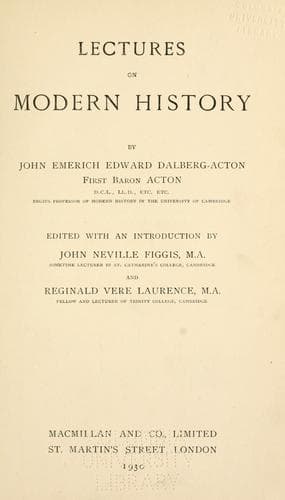
Lectures on Modern historyActon, John Emerich Edward Dalberg Acton, Baron
History
Lectures on Modern history
Acton, John Emerich Edward Dalberg Acton, Baron
History, Modern
Henry's institutions broke down immediately after his death. His
widow, Mary of Medici, was unequal to the task of continuing a policy
of independent action, relying on no group of friends and on no
established force of opinion. The clergy influenced her as they had
never influenced her husband. The princes of the blood, the great
nobles, the Protestants, became turbulent; and the states-general,
summoned for the last time before Lewis XVI, afforded no assistance:
The queen gave her confidence to Concini, a Florentine like herself,
whom she created a marshal of France. Her son, Lewis XIII, ordered
him to be killed in the courtyard of the palace; and his wife, the
queen's foster-sister, was put to death by complaisant judges. The
young king's favourite, Luynes, governed for a time, until the queen
obtained the first post for an adviser of her own, who was the
strongest Frenchman of the old regime.
With Richelieu, as with all great men, we do well to ascertain
low-water mark, that praise and admiration may not be carried too far.
He was not a good administrator, for he considered the general
interest, not that of any number of individual men. Every Frenchman
had felt the benefit of Henry's appeasing wisdom, and a season of
prosperity had ensued. But no individual was the better for
Richelieu's eighteen years of supreme office. He wasted the treasure
of ambitious enterprises, and sacrificed the happiness of the people
to the greatness of the king. No man was richer in sagacious maxims,
or in experience of mankind; but he was destitute of principle--I mean
of political principles, which are the guide of public life as moral
principles are the guide of our private lives. To serve his
deliberate purpose, he shrank from no arbitrary or violent excess,
putting innocent men to death without scruple, if he thought them
dangerous. In such cases, he said, it is better to do too much than
too little. He retained a superstitious belief in magic, and never
soared above his age with the vision of great truths and prevision of
the things to come. But he understood and relentlessly pursued the
immediate purpose of his time.
The work of Henry IV had been undone during his son's minority, and
had to be begun over again. The crown was only one among many rival
forces. Richelieu decided that they should all be made subject and
subservient, that the government alone should govern, not any men or
any group behind the government, striving for their own ends. He
meant that there should be no dominant interest but the reason of
State, no authority but the sovereign, no will but his own. He
pursued this object with perfect distinctness and resolution, and had
succeeded when he died in 1642.
Public-domain text, read in full here on John Shaqi.
Reviews
Reviews
No reviews yet
Be the first to share your thoughts on this work.
Elsewhere in the archive
Join the Discussion
Join the discussion
Sign in to leave a comment or review.
Sign InorCreate an account