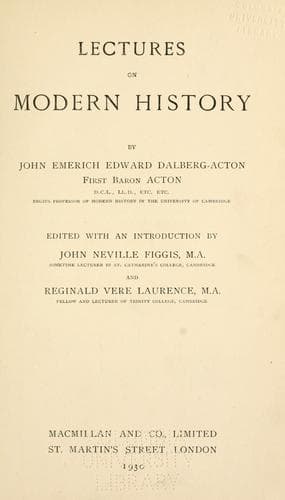
Lectures on Modern historyActon, John Emerich Edward Dalberg Acton, Baron
History
Lectures on Modern history
Acton, John Emerich Edward Dalberg Acton, Baron
History, Modern
The court was an obstacle. The queen-mother, who had made his
fortune, went against him, and the king's brother became a pivot of
conspiracy. For a moment, they triumphed. Lewis withdrew his
confidence from the too imperious and successful minister, who had
made his master so powerful and so helpless; but in one short
interview the cardinal recovered his position. The queen retired from
the council, went out of the country, and died, an exile, in the house
of Rubens at Cologne. When the greatest nobles of France, strong in
their feudal traditions, rose against his new, and illegal, and
oppressive authority, Richelieu repressed every attempt, and cut off
the head of every offender. For he said that clemency was the bane of
France.
The Huguenots, safe but not satisfied under Henry, had felt that they
were in danger after his death, and sought to transform the
self-government ceded to them at Nantes into a defensive association
against the sovereign. The spectre of federalism threatened the
hard-won unity of France, and challenged the very essence of
Richelieu's policy. The decisive struggle took place at La Rochelle.
Richelieu directed the siege himself, carrying out works as enormous
as those of the siege of Tyre, and infusing his spirit into men who
did not see that the political issue was superior to the military.
The English fleet outside was helpless to assist, and the starving
town yielded to the clerical warrior. Many thousands had perished,
fighting, as they averred, for toleration, in reality for
predominance.
The fall of Rochelle was the end of political Protestantism in France
as it issued from the civil war; of the attempt to imitate that which
the League had done, and to build up a confederation too strong for
the State. But the strictly religious privileges conceded thirty
years earlier were immediately renewed, and they were faithfully
observed. What Richelieu resisted implacably was disintegration, not
Calvinism. He had no difficulty in tolerating religious dissent. He
would not tolerate political opposition. Richelieu was a bishop, a
cardinal, a practised writer of theological controversy, a
passionately resolved defender of the national unity, and of the
French patriotism, which the religious struggle had imperilled, but he
was not intolerant. Under him, and under his successor, the Sicilian
Cardinal Mazarin, the religion which had been thought so dangerous was
allowed to prosper, and the highest offices were crowded with
Huguenots. The rapid expansion of French power was largely due to
this policy. It was then that the French proved superior to the
Spaniards in war, and the long supremacy of Spain came to an end on
land half a century after it had terminated at sea. Several of the
marshals were Protestants, including Turenne, the most illustrious of
them all. The tolerant spirit of the ecclesiastical statesmen caused
the rise of France, and its decline followed the intolerance of Lewis
XIV.
Public-domain text, read in full here on John Shaqi.
Reviews
Reviews
No reviews yet
Be the first to share your thoughts on this work.
Elsewhere in the archive
Join the Discussion
Join the discussion
Sign in to leave a comment or review.
Sign InorCreate an account