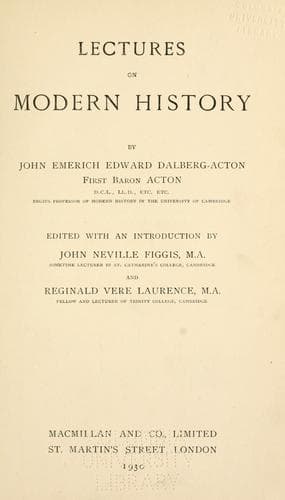
Lectures on Modern historyActon, John Emerich Edward Dalberg Acton, Baron
History
Lectures on Modern history
Acton, John Emerich Edward Dalberg Acton, Baron
History, Modern
Richelieu, if not deeply religious, was thoroughly a Churchman; but
his attitude towards Protestants separated him, on most fundamental
points, from the Spanish and Roman persecutors, and he differed
considerably from the great divines of the preceding generation.
He had just come to power when a book was published at Rome by
Sanctarelli renewing the theories of Bellarmin and Suarez, which had
excited the indignant resentment of the university and the Parliament.
Richelieu required the Paris Jesuits to renounce the doctrines which
their brethren proclaimed essential to orthodoxy. And they did what
he required of them, accepting, in France, the sentiments of France,
and protesting, at Rome, that they retained the sentiments of Rome.
They became the friends of their very arbitrary protector. When
Father Caussin, the king's confessor, warned him against the
cardinal's wars, and his Protestant alliances, his superiors agreed
to remove him.
Richelieu refused allegiance to system or party, and opposed the
Jansenist and the Gallican as he did the Jesuit extreme. He desired
to be aided, not hampered, by the Church and cultivated as much
independence as allowed friendship with Rome. Towards the end of his
life it was his object to become patriarch of France. The Pope who
reigned in his time had been in France when Cardinal Barberini. He
was a pontiff of a modern type, when compared with many of his recent
predecessors; and it was in his pontificate that the Roman Inquisition
put out its fires. He did not escape the influence of the Frenchman's
more vigorous personality. He shared his dread of the Habsburgs and
his interest in Gustavus, but they came to a breach at last.
It was in Richelieu's time, and under his auspices, that the great
division occurs between the modern Papacy and the medieval, which the
Counter-Reformation had revived. The striking contrast between France
under Richelieu and France under Lewis XIV is the tolerance of the one
and the intolerance of the other. But no spirit of independence could
be safe under the absolutism which the cardinal inaugurated, and which
was a glaring inconsistency as long as consciences were free. The
change, which was sure to come, came when, under very peculiar
constellations, Lewis XIV desired to show that he was a better
Catholic than the Pope.
Public-domain text, read in full here on John Shaqi.
Reviews
Reviews
No reviews yet
Be the first to share your thoughts on this work.
Elsewhere in the archive
Join the Discussion
Join the discussion
Sign in to leave a comment or review.
Sign InorCreate an account