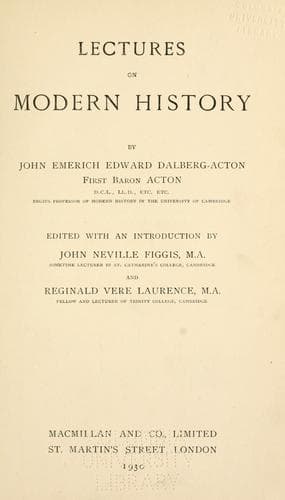
Lectures on Modern historyActon, John Emerich Edward Dalberg Acton, Baron
History
Lectures on Modern history
Acton, John Emerich Edward Dalberg Acton, Baron
History, Modern
The cardinal never abandoned the hope of healing the division of
churches, which was a calamity in his eyes, both as a statesman and a
divine. He provided for Huguenot ministers who were reconciled, and
he made serious plans to prepare for reunion, plans which Bossuet
resumed, but which had to be given up when the king resorted to
violence. The deepest part of the scheme to exalt the throne was the
endeavour to raise France above the nations. The opportunity was
afforded by the Thirty Years' War. All Europe was involved, the
Protestant Powers uniting against the House of Habsburg, which, by
tradition, by pretension, and by its actual position and power, was
the one constant obstacle to the desired supremacy of the French king.
Richelieu assisted them, and ended by openly joining them. Once he
said, "I will prove to the world that the age of Spain is passing away
and the age of France has come."
It was the contrast of two different epochs of civilisation, of two
worlds succeeding each other, rather than a conflict of rival Powers.
Spain was inseparably united with the Church and a declared enemy to
the rest of Christendom. France lived at peace with Protestants, and
based her policy on their support, having political but not religious
enemies to combat, gaining all that Spain lost by exclusiveness. It
was the adoption of a new doctrine. The interest of the State above
the interest of the Church, of the whole above the aggregate of parts,
determined the foreign as well as the domestic policy of the
statesmanlike prelate. The formidable increase of State power, in the
form of monarchy, was an event of European proportion and
significance. General History naturally depends on the action of
forces that are not national, but proceed from wider causes. The rise
of modern kingship in France is part of a similar movement in England.
Bourbon's and Stuarts obeyed the same law, though with a different
result.
X
THE THIRTY YEARS' WAR
THE LAST and most important product of the Counter-Reformation was the
Thirty Years' War. In Germany the rights of the churches had been
defined by the Peace of Religion, and the principles of the
settlement were not seriously contested.
Public-domain text, read in full here on John Shaqi.
Reviews
Reviews
No reviews yet
Be the first to share your thoughts on this work.
Elsewhere in the archive
Join the Discussion
Join the discussion
Sign in to leave a comment or review.
Sign InorCreate an account