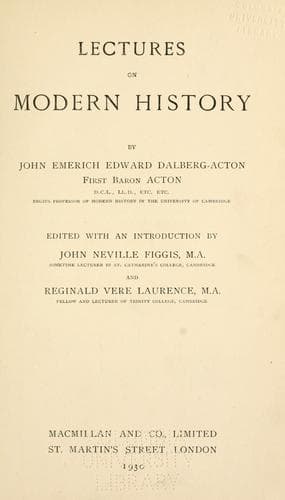
Lectures on Modern historyActon, John Emerich Edward Dalberg Acton, Baron
History
Lectures on Modern history
Acton, John Emerich Edward Dalberg Acton, Baron
History, Modern
When, the Archbishop of Cologne married and became a Protestant, he
endeavoured to retain his political position as one of the electors;
but the Catholics were strong enough to prevent it, as a thing
foreseen and clearly provided against by law. There had been a
constant propaganda on both sides, each gaining ground in some
direction, the Lutherans losing much by the extension of Calvinism at
their expense. By operation of the accepted maxim that the civil
power shall determine which religion may be practised within its
territory, Lutheran governments becoming Calvinist carried their
subjects with them, weakening the Protestant cause, and presenting a
divided front to opponents. In this matter there was one significant
exception. The House of Brandenburg became Calvinist, the country
remained Lutheran, while the minister, Schwarzenberg, was a Catholic.
To this timely divergence from the ideas and customs of the sixteenth
century, to this fundamentally different view of the function and uses
of the State, the Hohenzollerns owe no small portion of their
greatness in history. The Protestants were in the majority, but the
Imperial government was still in Catholic hands.
In the hereditary dominions of the House of Habsburg the situation was
different. Under Maximilian II Austria had been the least intolerant
of European governments. Equal toleration prevailed at that time in
Poland, and led to the growth and prosperity of the Socinians; but the
Austrian policy aimed at a compromise between the churches, and at a
system of concessions which made them much alike.
Under Maximilian's inefficient son, the country went asunder. One
branch of the family carried out the Counter-Reformation in Styria;
while, north of the Danube, the majority of the inhabitants was
either Lutheran or Utraquist, that is, attached to Communion under
both kinds, which had been the germ of Hussitism, and was the residue
that remained after the fervour of the Hussite movement had burnt
itself out. In 1609 Bohemia and Silesia obtained entire freedom of
religious belief; while in the several provinces of Alpine Austria
unity was as vigorously enforced as the law permitted--that is, by the
use of patronage, expulsion of ministers, suppression of schools;
confiscation of books, and, generally, by administrative repression,
short of violence.
Public-domain text, read in full here on John Shaqi.
Reviews
Reviews
No reviews yet
Be the first to share your thoughts on this work.
Elsewhere in the archive
Join the Discussion
Join the discussion
Sign in to leave a comment or review.
Sign InorCreate an account