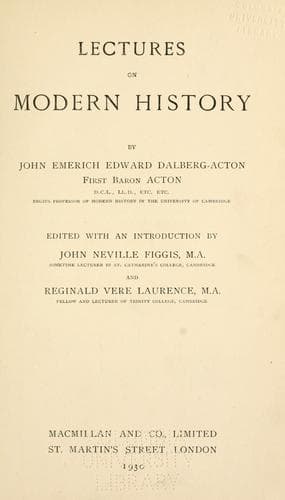
Lectures on Modern historyActon, John Emerich Edward Dalberg Acton, Baron
History
Lectures on Modern history
Acton, John Emerich Edward Dalberg Acton, Baron
History, Modern
The Bohemian leaders saw the danger of submitting to a man who,
without being a persecutor like Henry VIII and Philip II, would know
how to oppress them wisely. Their crown had once been elective; and
the ceremony of election had been revived ten years before when the
last king ascended the throne. They resolved to resist Ferdinand, and
to call another in his place. War would inevitably follow; and in
order that the country might be committed to their quarrel, as there
was no strong popular movement at first, and no national or political
issue, they judged that they must begin by giving proof of their
deadly meaning. The conspirators, with Count Thurn at their head,
made their way into the Hradschin, the gloomy palace that overlooks
Prague, and deliberately threw two hostile members of the government,
Slavata and Martinitz, out of the window. It seems that there is a
contagious charm about that sort of exercise which is not evident to
those who have not practised it. For seeing an inoffensive secretary,
Fabricius, who was trying to make himself as small as possible in the
crowd, they threw him after the others. The victims had a fall of
fifty feet. None of the three was much the worse for it, or for the
shots that were fired at them; and it is difficult to account for
their escape.
Ferdinand, who possessed no army, and was not safe in his palace at
Vienna from the insurgents who sympathised with Prague, had no means
of coping with the insurrection. He turned for aid to his friends in
Germany. There, defensive confederacies had been formed both by
Protestants and Catholics. The Catholics, consisting chiefly of
ecclesiastical princes with the Duke of Bavaria at their head,
composed what was known as the League, to protect their interests
against more aggressive adversaries. And the aggressive adversaries,
chiefly Calvinists, for Lutherans combined more easily with Catholics,
constituted what was called the Union. For some time they had
expected hostilities, and were preparing recruits. There was no lack
of fighting material; but the nation was poor in organisation, and ill
supplied with money, and was therefore insufficiently armed. They
looked abroad for auxiliaries--the Union, to Savoy and Venice, Holland
and England; the League, to Spain. Henry IV had been on the point of
seizing the occasion of this open rivalry, and of a disputed
succession, to invade the Empire in the summer of 1610. After his
death France dropped for a time out of European complications, and
thereby helped to postpone the outbreak of expected war. After the
insane and stupid outrage at Prague it became an immediate certainty,
and Maximilian of Bavaria, the ablest prince who ever reigned in that
country, came to the aid of his cousin the emperor, with his own
statesmanship, the forces of the League, and an ever-victorious
general. The Bohemians had the support of the Union; and the chief of
the Union, the elector Palatine, was elected to be their king.
Public-domain text, read in full here on John Shaqi.
Reviews
Reviews
No reviews yet
Be the first to share your thoughts on this work.
Elsewhere in the archive
Join the Discussion
Join the discussion
Sign in to leave a comment or review.
Sign InorCreate an account