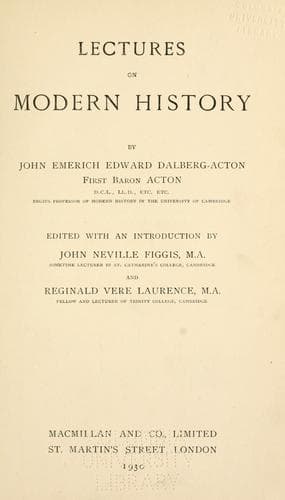
Lectures on Modern historyActon, John Emerich Edward Dalberg Acton, Baron
History
Lectures on Modern history
Acton, John Emerich Edward Dalberg Acton, Baron
History, Modern
For our present purpose, then, I describe as Modern History that which
begins four hundred years ago, which is marked off by an evident and
intelligible line from the time immediately preceding, and displays in
its course specific and distinctive characteristics of its own #10.
The modern age did not proceed from the medieval by normal succession,
with outward tokens of legitimate descent. Unheralded, it founded a
new order of things, under a law of innovation, sapping the ancient
reign of continuity. In those days Columbus subverted the notions of
the world, and reversed the conditions of production, wealth, and
power; in those days Machiavelli released government from the
restraint of law; Erasmus diverted the current of ancient learning
from profane into Christian channels; Luther broke the chain of
authority and tradition at the strongest link; and Copernicus erected
an invincible power that set for ever the mark of progress upon the
time that was to come. There is the same unbound originality and
disregard for inherited sanctions in the rare philosophers as in the
discovery of Divine Right, and the intruding Imperialism of Rome. The
like effects are visible everywhere, and one generation beheld them
all. It was an awakening of new life; the world revolved in a
different orbit, determined by influences unknown before. After many
ages persuaded of the headlong decline and impending dissolution of
society #11, and governed by usage and the will of masters who were in
their graves, the sixteenth century went forth armed for untried
experience, and ready to watch with hopefulness a prospect of
incalculable change.
Public-domain text, read in full here on John Shaqi.
Reviews
Reviews
No reviews yet
Be the first to share your thoughts on this work.
Join the Discussion
Join the discussion
Sign in to leave a comment or review.
Sign InorCreate an account