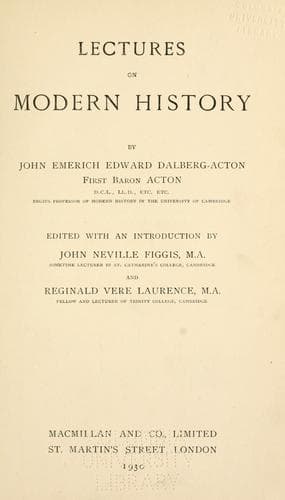
Lectures on Modern historyActon, John Emerich Edward Dalberg Acton, Baron
History
Lectures on Modern history
Acton, John Emerich Edward Dalberg Acton, Baron
History, Modern
AT THE death of Elizabeth, England separated from the Continent
in politics, and moved thenceforth in a different direction. Long
before, political observers like Commynes and Fortescue recognised the
distinctive character and the superiority of the insular institutions;
but these were not strong enough to withstand the Tudors, and the work
had to be begun over again. It was begun, upon the ancient ways, with
tradition and precedent; and when that was found to be not quite
convincing, it was pursued by means of new, general, and revolutionary
principles. The combination, or alteration, of these methods of
policy is the peculiar note of the times before us.
When King James of Scotland became King James of England, the country
obtained the benefit of being an island, protected by the sea. There
was no longer a hostile and warlike neighbour, compelling military
preparation and the concentration of power, which made foreign
governments absolute. An English officer once congratulated Moltke on
the splendid army which he had created and led. The marshal shook his
head, and replied that the German army was a terrible burden on the
country, but that the long Russian frontier made it a necessity.
James, who had been helpless at home against the nobles and the Kirk,
conceived high notions of authority, high ideals of what a monarch may
legitimately do for his country, acting by his own lights, his own
will, his own conscience, not as flotsam on the changing and uncertain
wave of opinion. And he came to England expecting that its wealth and
civilisation, and its intellectual culture, which reached just then
its culminating point, would afford a more favourable field for
advanced theories of State. The Stuarts owed something to each of the
two strongest and most obvious currents of political thought in their
time. From Machiavelli they took the idea of the State ruling itself,
for its own ends, through experts, not depending on the forces of
society or the wishes of men uninformed upon complex problems of
international policy, military administration, economy and law. And
they adopted from Luther his new and admired dogma of the divine right
of kings. They consistently rejected an opposite theory, well known
to James from his teacher Buchanan, derived from Knox and his medieval
masters, and wrongly imputed to Calvin--the theory of revolution.
They had the judges with them, that is, the laws of England. They had
the Established Church, the keepers of conscience and consecrated
expounders of the divine will. They had the successful example of the
Tudors, showing that a government may be absolute and at the same time
popular, and that liberty was not the supreme desire of English
hearts. And they had the general drift and concurrence of Europe, as
well as of the intellectual world at home, of Hooker, of Shakespeare,
and of Bacon. The best philosophers, the most learned divines, many
Public-domain text, read in full here on John Shaqi.
Reviews
Reviews
No reviews yet
Be the first to share your thoughts on this work.
Elsewhere in the archive
Join the Discussion
Join the discussion
Sign in to leave a comment or review.
Sign InorCreate an account