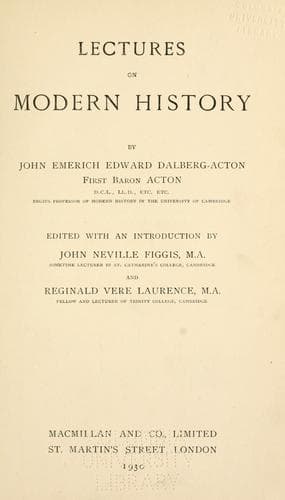
Lectures on Modern historyActon, John Emerich Edward Dalberg Acton, Baron
History
Lectures on Modern history
Acton, John Emerich Edward Dalberg Acton, Baron
History, Modern
even of the most consummate jurists in the universe sustained their
cause. They were not bound to believe that idle squires or provincial
busybodies understood the national interest and the reason of State
better than trained administrators, and claimed to be trusted in the
executive as they were in the judiciary. Their strength was in the
clergy, and the Anglican clergy professed legitimacy and passive
obedience, in indignant opposition to the Jesuits and their votaries.
The king could not be less monarchical than the divines; he could not
renounce their support; and the bond between them was therefore a
close one. Starting from the position that the sovereign will shall
control and not be controlled, there was no certain evidence that the
opposition to it would be deep, or formidable, or sincere. The quick
increase of the middle class, which was the seat of sectarianism,
could not well be discovered from the returns of taxation. The
Stuarts might fairly be persuaded that they were not only wiser than
their opponents, but more liberal than they, for the Puritans
repeatedly demanded that the wages of heresy should be death. The
distinction in point of liberality between King and parliament is
manifest in the Catholic question.
James I wished to avoid persecution. In discussion with two superior
men, Andrewes and Casaubon, he developed conciliatory views pointing
to eventual reunion. His mother had been the champion and martyr of
Catholic monarchy. His wife was a convert of the Jesuits. He
regarded the Penal Laws as defensible on the ground of political
danger only, not on the ground of religion. He desired to obtain a
working arrangement with Rome, which should ensure the loyalty of the
Catholics, in return for the inestimable benefit of toleration. Pope
Clement VIII, Aldobrandini, was not satisfied, and sent instructions
that James should not be acknowledged unless he pledged himself to
much larger concessions. He feared, he said, to go too far in favour
of a heretic. His briefs were not made public, but they came to the
knowledge of Catesby, to whom they were very welcome. A king who
might not be acknowledged was a king who might be deposed. When his
advances were rejected, James issued a proclamation against the
priests, which was the determining provocation of the plot. The
violence with which Elizabeth defended her life against a multitude of
conspirators was easily understood. But her successor was under no
sentence of deprivation, and the legitimacy of his claim was untouched
by arguments forged against the daughter of Anne Boleyn. The
Catholics had reasonably hoped that the better treatment which they
received at the beginning of the new reign, of the new dynasty, would
be continued.
Public-domain text, read in full here on John Shaqi.
Reviews
Reviews
No reviews yet
Be the first to share your thoughts on this work.
Elsewhere in the archive
Join the Discussion
Join the discussion
Sign in to leave a comment or review.
Sign InorCreate an account