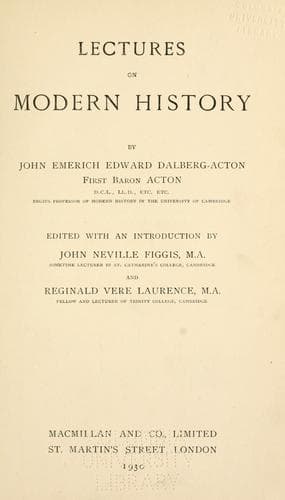
Lectures on Modern historyActon, John Emerich Edward Dalberg Acton, Baron
History
Lectures on Modern history
Acton, John Emerich Edward Dalberg Acton, Baron
History, Modern
Under the shock of disappointment some deemed themselves absolved from
allegiance, and left to their own means of self-defence. They
regarded James as their aggressor. We cannot tell how much they knew
of the odious filthiness of his private life and conversation, which
foreign envoys described in language which nobody has ever had the
courage to print. In any group there might be desperate and
passionate men capable of devising crimes which they disguised under
the gilding of a higher purpose. We have seen some of them at the
murder of Riccio and the defenestration of Prague. But here there
were deeper waters. Some of the accomplices, such as Digby, were men
otherwise of blameless and honourable character, who could not be
accused of hypocrisy. Then certain leading Jesuits were implicated.
They were so far from encouraging the scheme that they procured from
Rome a formal prohibition of violent designs. But they gave no hint
of danger, and their silence was defended on the ground that although
a general warning might have been given to save a Catholic prince, the
seal of confession was absolute as against a Protestant.
A belief arose that these people were incorrigible. The precedent of
1572 established the right of murder. The doctrinaires of the League
and their contemporaries added to it the right of revolution, applying
to princes the rule followed against less exalted Protestants. How
theorists were divided, or by what subtle exceptions the theory was
qualified, nobody rightly knew. The generation that had beheld Guy
Fawkes remained implacable. Not so King James. He resolved to
perpetuate a broad division between the men of blood and their
adversaries, and he founded thereon the oath of allegiance, which did
no good. The Stuarts could honestly believe that the motives of
persecuting parliaments were not inspired by a genuine sense of public
duty, and that they themselves were defending the sacred cause against
furious oppressors. The issues are not as plain, the edge is not as
sharp as we suppose when we look back on the result. The question to
be fought out between king and parliament was not monarchy or
republic, democracy or aristocracy, freedom or the proteus that
resists or betrays freedom. At many points the Stuart cause resembles
that of constitutional monarchy on the Continent, as it was in France
under Lewis XVIII, and in Prussia under the Emperor William. If
Bismarck had been there he would have been the strength of the
Royalists, and Cromwell might have met his match.
On almost every occasion, under James I, opposition made itself felt,
and it became practically important, and anticipated the future in
1621. Then the Commons, guided by the most famous English lawyer,
Coke, struck down Bacon, and deprived the Stuarts of the ablest
counsellor they ever had. Impeachment and responsibility of ministers
remained.
Public-domain text, read in full here on John Shaqi.
Reviews
Reviews
No reviews yet
Be the first to share your thoughts on this work.
Elsewhere in the archive
Join the Discussion
Join the discussion
Sign in to leave a comment or review.
Sign InorCreate an account