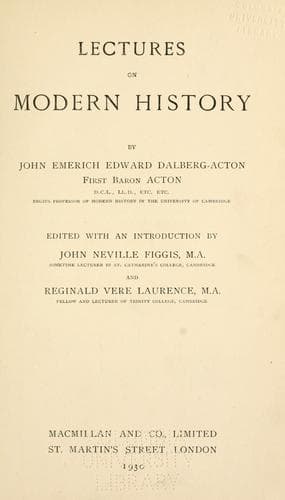
Lectures on Modern historyActon, John Emerich Edward Dalberg Acton, Baron
History
Lectures on Modern history
Acton, John Emerich Edward Dalberg Acton, Baron
History, Modern
Pitt, drawn by an enthusiastic crowd, went
to dine in the city. When they drank the health of the minister
who had saved his country, he declined the praise. "England,"
he said, "has saved herself by her own energy; and I hope that
after having saved herself by her energy, she will save Europe
by her example." In 1814, when this hope had been realised,
the last speech of the great orator was remembered, and a medal
was struck upon which the whole sentence was engraved, in four
words of compressed Latin: _Seipsam virtute, Europam exemplo_.
Now it was just at the time of his last appearance in public that
Mr. Pitt heard of the overwhelming success of the French in
Germany, and of the Austrian surrender at Ulm. His friends
concluded that the contest on land was hopeless, and that it was
time to abandon the Continent to the conqueror, and to fall back
upon our new empire of the sea. Pitt did not agree with them.
He said that Napoleon would meet with a check whenever he
encountered a national resistance; and he declared that Spain was
the place for it, and that then England would intervene #85. General
Wellesley, fresh from India, was present. Ten years later, when
he had accomplished that which Pitt had seen in the lucid
prescience of his last days, he related at Paris what I scarcely
hesitate to call the most astounding and profound prediction in
all political history, where such things have not been rare.
I shall never again enjoy the opportunity of speaking my thoughts
to such an audience as this, and on so privileged an occasion a
lecturer may well be tempted to bethink himself whether he knows
of any neglected truth, any cardinal proposition, that might
serve as his selected epigraph, as a last signal, perhaps even as
a target. I am not thinking of those shining precepts which are
the registered property of every school; that is to say--Learn as
much by writing as by reading; be not content with the best book;
seek sidelights from the others; have no favourites; keep men and
things apart; guard against the prestige of great names #86; see that
your judgments are your own, and do not shrink from disagreement;
no trusting without testing; be more severe to ideas than to
actions #87; do not overlook the strength of the bad cause or the
weakness of the good #88; never be surprised by the crumbling of an
idol or the disclosure of a skeleton; judge talent at its best
and character at its worst; suspect power more than vice #89, and
study problems in preference to periods; for instance: the
derivation of Luther, the scientific influence of Bacon, the
predecessors of Adam Smith, the medieval masters of Rousseau, the
consistency of Burke, the identity of the first Whig. Most of
this, I suppose, is undisputed, and calls for no enlargement.
But the weight of opinion is against me when I exhort you never
to debase the moral currency or to lower the standard of
rectitude, but to try others by the final maxim that governs your
Public-domain text, read in full here on John Shaqi.
Reviews
Reviews
No reviews yet
Be the first to share your thoughts on this work.
Join the Discussion
Join the discussion
Sign in to leave a comment or review.
Sign InorCreate an account