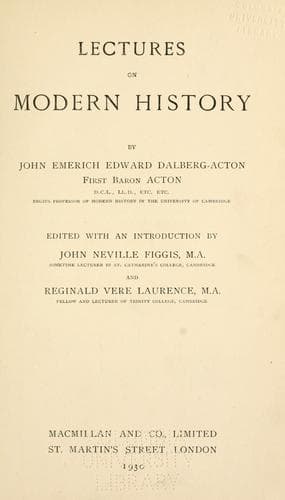
Lectures on Modern historyActon, John Emerich Edward Dalberg Acton, Baron
History
Lectures on Modern history
Acton, John Emerich Edward Dalberg Acton, Baron
History, Modern
From the first years of the century we have been quickened and
enriched by contributors from every quarter. The jurists brought
us that law of continuous growth which has transformed history
from a chronicle of casual occurrences into the likeness of
something organic #76. Towards 1820 divines began to recast their
doctrines on the lines of development, of which Newman said, long
after, that evolution had come to confirm it #77. Even the
Economists, who were practical men, dissolved their science into
liquid history, affirming that it is not an auxiliary, but the
actual subject-matter of their inquiry #78. Philosophers claim that,
as early as 1804, they began to bow the metaphysical neck beneath
the historical yoke. They taught that philosophy is only the
amended sum of all philosophies, that systems pass with the age
whose impress they bear #79, that the problem is to focus the rays of
wandering but extant truth, and that history is the source of
philosophy, if not quite a substitute for it #80. Comte begins a
volume with the words that the preponderance of history over
philosophy was the characteristic of the time he lived in. Since
Cuvier first recognised the conjunction between the course of
inductive discovery and the course of civilisation #82, science had
its share in saturating the age with historic ways of thought,
and subjecting all things to that influence for which the
depressing names historicism and historical-mindedness have been
devised.
There are certain faults which are corrigible mental defects on
which I ought to say a few denouncing words, because they are
common to us all. First: the want of an energetic understanding
of the sequence and real significance of events, which would be
fatal to a practical politician, is ruin to a student of history,
who is the politician with his face turned backwards #83. It is
playing at study, to see nothing but the unmeaning and unsuggestive
surface, as we generally do. Then we have a curious proclivity
to neglect, and by degrees to forget, what has been certainly known.
An instance or two will explain my idea. The most popular English
writer relates how it happened in his presence that the title of
Tory was conferred upon the Conservative party. For it was an
opprobrious name at the time, applied to men for whom the Irish
Government offered head-money; so that if I have made too sure
of progress, I may at least complacently point to this instance
of our mended manners. One day, Titus Oates lost his temper
with the men who refused to believe him, and, after looking
about for a scorching imprecation, he began to call them Tories
#84. The name remained; but its origin, attested by Defoe,
dropped out of common memory, as if one party were ashamed of
their godfather, and the other did not care to be identified
with his cause and character. You all know, I am sure,
the story of the news of Trafalgar, and how, two days after it
had arrived, Mr.
Public-domain text, read in full here on John Shaqi.
Reviews
Reviews
No reviews yet
Be the first to share your thoughts on this work.
Join the Discussion
Join the discussion
Sign in to leave a comment or review.
Sign InorCreate an account