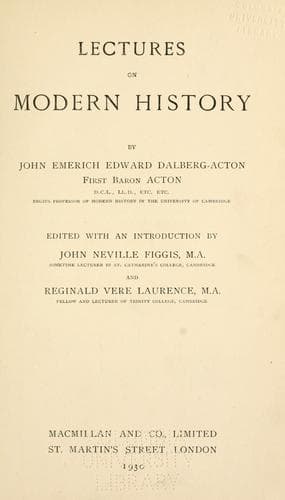
Lectures on Modern historyActon, John Emerich Edward Dalberg Acton, Baron
History
Lectures on Modern history
Acton, John Emerich Edward Dalberg Acton, Baron
History, Modern
It was no secret that James was resolved to be master, and to abolish
the restraints and safeguards of the constitution. Penn, reporting his
intentions to William of Orange, declared that he would have all or
nothing. He had repeatedly avowed that he meant to do it by a standing
army and by claiming the right to dispense with laws. Monmouth's
rebellion gave him the standing army. Although it was unsupported
either by the exclusionists or the limitationists, and although it was
contemptibly managed, there had been a moment of serious danger. It
was the general opinion that the night attack at Sedgemoor would have
succeeded, and that the royal army would have been destroyed, if the
rebels, instead of betraying their approach with musketry, had come to
close quarters with axe and scythe. The king took advantage of what
had happened, and he had the means of paying a force which amounted to
14,000 men.
Charles had been in perpetual want of money through the expensive
scandals of his court. There were half a dozen ducal titles needing
to be provided with ducal incomes, and obliging the king to become a
dependent pensionary of the liberal paymaster in France. At his death
all this was changed, and Catharine Sedley disappeared from Whitehall.
It is true that her absence was not prolonged, and that she had
obscurer rivals. But a decorous economy was observed in a branch of
expenditure which had been profuse. Nevertheless Lewis XIV hastened
to make offers of pecuniary aid to the frugal James as to the
extravagant Charles. He sent over a sum of L60,000 or L70,000,
consisting partly of arrears already due. This was to be paid only if
James found himself in difficulties after having proclaimed liberty of
conscience. If there was no disturbance, there was to be no payment.
And when the session ended without any measure of the kind, Lewis gave
orders that the money should be returned to him. In the autumn of
1685 James proceeded to adopt his advice. He had been victorious.
His birthday, in October, was celebrated more heartily than his
brother's had ever been, and the atrocities of the Western Assize did
not affect opinion to his disadvantage.
Public-domain text, read in full here on John Shaqi.
Reviews
Reviews
No reviews yet
Be the first to share your thoughts on this work.
Elsewhere in the archive
Join the Discussion
Join the discussion
Sign in to leave a comment or review.
Sign InorCreate an account