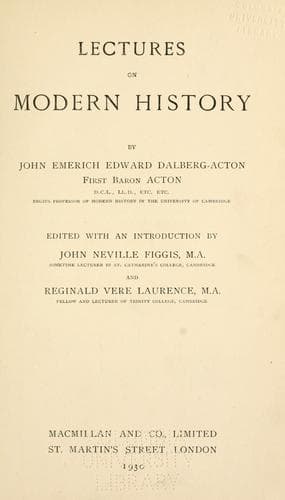
Lectures on Modern historyActon, John Emerich Edward Dalberg Acton, Baron
History
Lectures on Modern history
Acton, John Emerich Edward Dalberg Acton, Baron
History, Modern
He made known his plans. Besides the standing army and the recall of
the Habeas Corpus, he demanded the dispensing power. Nobody supposed
that the head of the executive was to persecute his own religion. To
admit his right of succession was to admit that the Elizabethan Code
was to be practically dormant. The Catholic desired no more. It was
enough that they ceased to suffer oppression. Halifax, the ablest
though not the strongest of James's ministers, agreed to that, and did
not object to a moderate number of Catholic officers. The Prince of
Orange was of the same opinion. Toleration was therefore assured, and
the era of persecution had passed away. That was of no use to Lewis
XIV, who in that month of October suppressed the Protestant religion
in France. And it was of little use to James himself, as it added
nothing to his power. He insisted on introducing toleration by
dispensing with the laws, by right of his prerogative, and on
abolishing the Test Act. But the Test Act was a security against
arbitrary power, by depriving him of the assistance of Catholics in
office. His desire for arbitrary power was notorious, and the country
did not believe that his zeal for the liberty of conscience was
sincere. They believed, and they believed rightly, that he demanded
more than that which would satisfy the just and obvious necessities of
his Church in order to strengthen his prerogative, and that he was
tolerant in order that he might be absolute. He professed openly the
maxim that toleration was the necessary condition of absolutism. He
urged Lewis, secretly, to pursue the work of the revocation, and was
reluctant to allow collections to be made for the Huguenot fugitives.
Later, when he was himself an exile, and nothing could be more
inopportune than the profession of tolerant sympathies at the French
court, he seriously and consistently proclaimed them. And it is very
possible that he was then sincere, and that a change had taken
place. Another change took place when he became acquainted with the
famous Rance, who had made the abbey of La Trappe the most edifying
seat of religion in France, and a favourite retreat for men like
Bossuet and St. Simon. James also visited him and corresponded with
him, and sixty of their letters are extant. At Versailles people did
not understand how so much devotion could be combined with so much
tolerance in religion. The letters to Rance show that the religion of
James, when he was on the throne, was very near the surface. Whether
it was different afterwards, as they believed in France, is not quite
certain. And in this connection it will be convenient to mention the
assassination plot.
Public-domain text, read in full here on John Shaqi.
Reviews
Reviews
No reviews yet
Be the first to share your thoughts on this work.
Elsewhere in the archive
Join the Discussion
Join the discussion
Sign in to leave a comment or review.
Sign InorCreate an account