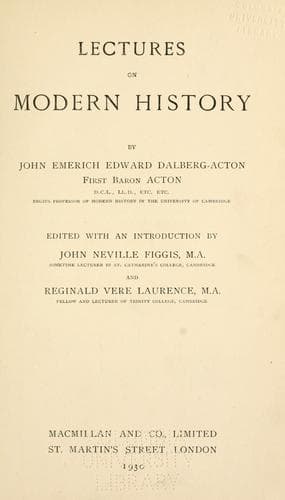
Lectures on Modern historyActon, John Emerich Edward Dalberg Acton, Baron
History
Lectures on Modern history
Acton, John Emerich Edward Dalberg Acton, Baron
History, Modern
The reign of James came to an end when he fled from the Boyne to St.
Germains. He became the king of the Nonjurors. In 1693, when the
French had been victorious at Steenkerk and Landen, he issued a
Declaration, with the doubting approval of French divines, which the
nonjuring bishops repudiated. Such concessions, they affirmed, would
ruin the monarchy. Kerr was of the same opinion; but he went on to
say that when the Declaration had served its purpose and restored the
king, he would not be bound to observe it. The war was unprofitable
to the allies on land; but after the victory of La Hogue the three
kingdoms were safe from invasion. This is the war to which we owe the
National Debt, the Bank of England, the growth of the moneyed
interest.
But the agrarian interest still largely predominated, and the
landlords, as the ruling class, required a reward for their share in
the elevation of William. Nineteen years earlier the Corn Laws had
been invented for their benefit. Protection against foreign
importation did much; but in 1689 a premium on the exportation of
English-grown corn was added, and it is this which caused the immense
prosperity of English agriculture in the eighteenth century, enriching
the landlord with capital at the expense of the yeoman without it.
Two of our greatest writers, to speak truly, our two greatest writers,
Burke and Macaulay, have taken pains to show that the Revolution of
1688 was not revolutionary but conservative, that it was little more
than a rectification of recent error, and a return to ancient
principles. It was essentially monarchical. The king was
acknowledged to be a necessity in the then state of England. The idea
of a Commonwealth did not appear. The Revolution was mainly the work
of Conservatives, that is, of Churchmen who, where Church interests
were not threatened, strictly upheld authority, and reverted to their
original doctrine when the crisis was over. No change took place in
the governing class. The gentry who managed the affairs of the county
managed the affairs of the country after 1688 as they had done before.
There was no transfer of force from the aristocratic element of
society to the democratic. The essentials of free government,
religious liberty, national education, emancipation of slaves, freedom
of trade, relief of poverty, freedom of the press, solidarity of
ministers, publicity of debates, were not mentioned in the resolutions
of the Convention or in the Bill of Rights. Nothing was done to
determine whether the future belonged to the Tory or the Whig.
Public-domain text, read in full here on John Shaqi.
Reviews
Reviews
No reviews yet
Be the first to share your thoughts on this work.
Elsewhere in the archive
Join the Discussion
Join the discussion
Sign in to leave a comment or review.
Sign InorCreate an account