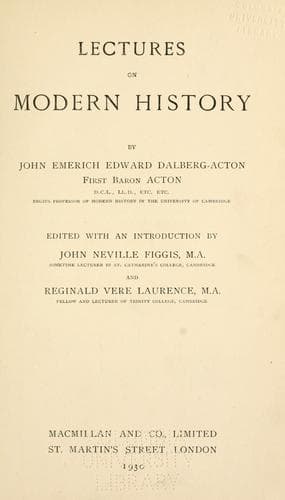
Lectures on Modern historyActon, John Emerich Edward Dalberg Acton, Baron
History
Lectures on Modern history
Acton, John Emerich Edward Dalberg Acton, Baron
History, Modern
And yet it is the greatest thing done by the English nation. It
established the State upon a contract, and set up the doctrine that a
breach of contract forfeited the crown--the former, in the English
convention; the latter, in the Scottish. Parliament gave the crown,
and gave it under conditions. Parliament became supreme in
administration as well as in legislation. The king became its servant
on good behaviour, liable to dismissal for himself or his
ministers. All this was not restitution, but inversion. Passive
obedience had been the law of England. Conditional obedience and the
right of resistance became the law. Authority was limited and
regulated and controlled. The Whig theory of government was
substituted for the Tory theory on the fundamental points of political
science. The great achievement is that this was done without
bloodshed, without vengeance, without exclusion of entire parties,
with so little definiteness in point of doctrine that it could be
accepted, and the consequences could be left to work themselves
out. The Act itself was narrow, spiritless, confused, tame, and
unsatisfactory. It was perfectly compatible with the oppression of
class by class, and of the country by the State, as the agent of a
class. It was strangely imperfect.
The consequences ripened slowly, and a time came, under George III,
when it seemed that they were exhausted. It was then that another and
a more glorious Revolution, infinitely more definite and clear-cut,
with a stronger grasp of principle, and depending less on conciliation
and compromise, began to influence England and Europe.
XIV
LEWIS THE FOURTEENTH
WHILST ENGLAND was traversing the revolutionary period on its arduous
course towards free government, France completed, with universal
applause, the structure of absolute monarchy. Neither Henry IV nor
Richelieu had done enough to secure the country against conspiracy,
disorder, and invasion. There was a relapse into civil war during
each minority, under Lewis XIII and Lewis XIV; the nobles and the
magistrates turned against the crown, and a prince of the blood,
Conde, commanded the Spaniards in a campaign on French soil against
the royal army. With the aid of Turenne, Mazarin triumphed over every
danger, and the young king was anointed in the Cathedral of Rheims.
Public-domain text, read in full here on John Shaqi.
Reviews
Reviews
No reviews yet
Be the first to share your thoughts on this work.
Elsewhere in the archive
Join the Discussion
Join the discussion
Sign in to leave a comment or review.
Sign InorCreate an account