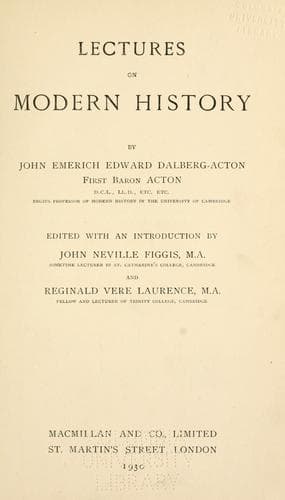
Lectures on Modern historyActon, John Emerich Edward Dalberg Acton, Baron
History
Lectures on Modern history
Acton, John Emerich Edward Dalberg Acton, Baron
History, Modern
In 1659, by the Peace of the Pyrenees, the cardinal terminated
victoriously the long war with Spain, which began in the middle of the
Thirty Years' War, and outlasted it, and established the supremacy of
France over the Continent. The one desire of France was the
concentration of power, that there might be safety abroad and order at
home. To ensure this, more was required than the genius of even the
most vigorous and astute ministers in the world. Neither Richelieu,
who was a bishop, nor Mazarin, who was a foreigner, could be
identified with the State. What was wanted had been wanting in France
for half a century--the personality of the king, monarchy personified,
with as much splendour, as much authority, as much ascendency, as
would fill the national imagination and satisfy national pride. The
history of Charles I, the restoration of Charles II, the outbreak of
loyal sentiment, which was stronger than religion, which was itself a
religion, showed that there was something in royalty higher than the
policy of statesmen, and more fitted to inspire the enthusiasm of
sacrifice.
At the death of Mazarin there was no man capable of being his
successor. Le Tellier, Colbert, Lionne were men of very great
ability, but they were departmental ministers. The young Monarch gave
orders that, as they had reported to the cardinal, they should now
report to himself. He added that they were to assist him with their
advice whenever he asked for it; and he did not make it appear that he
would trouble them often. The initiative of government passed into
his hands. He did not say, "L'etat, c'est moi." Those words, I
believe, were invented by Voltaire, but they are profoundly true. It
was the thing which occasion demanded, and he was the man suited to
the occasion.
Public-domain text, read in full here on John Shaqi.
Reviews
Reviews
No reviews yet
Be the first to share your thoughts on this work.
Elsewhere in the archive
Join the Discussion
Join the discussion
Sign in to leave a comment or review.
Sign InorCreate an account