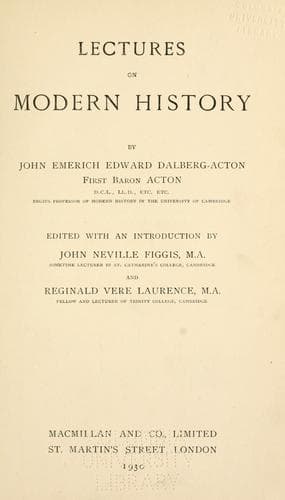
Lectures on Modern historyActon, John Emerich Edward Dalberg Acton, Baron
History
Lectures on Modern history
Acton, John Emerich Edward Dalberg Acton, Baron
History, Modern
Walpole's main idea on taking the highest office, that which he
proclaimed in his first king's speech, was to divert the country from
frantic speculation to the legitimate profits of industry and trade.
The two great openings for trade were with the Mediterranean and with
Spanish America. That with the Mediterranean was somewhat neglected,
as the government relied more on the friendship of the piratical
Algerines than on the solid possession of Gibraltar and Minorca.
George I had written a letter to Philip V, dated 1st June, 1721, in
which he distinctly assured him of his "readiness to satisfy with
regard to your demand relating to the restitution of Gibraltar,
promising you to make use of the first favourable opportunity to
regulate this article with consent of my parliament." The English
ministry were not convinced of the importance of retaining Gibraltar,
and fully expected to be in a position to give it up to Spain for an
equivalent. Indeed, in January 1721, Stanhope had said to the French
envoy that in a year, when the financial position of England was
better and the temper of parliament improved, they would certainly
give up Gibraltar, for the merest shadow of an equivalent, as the
place was only a burden to them. But they had not counted on the
determination of the English people to hold it at all costs. Philip,
however, not perhaps without some reason, always regarded the
engagement as precise, and treated the continued retention as an act
of bad faith. In all that I have just said about Gibraltar, I have
been quoting a recent writer in the Historical Review.
The South American trade presented infinite possibilities. It was
pursued with difficulty against the resistance of the Spaniards, who
had the law on their side. It was considered worth a war, and the
strength of public feeling overcame the feeble scruples of the
minister. The war ended disastrously, but before the end Walpole had
been driven from office. It had been no part of his policy to promote
prosperity by arms, but it was part of his policy, and the deciding
part of it, to let the nation, in the last instance, regulate its own
affairs. Peace was a good thing; but profit was also a good thing;
and Walpole had no principle that made one a question of duty and the
other a question of interest.
Public-domain text, read in full here on John Shaqi.
Reviews
Reviews
No reviews yet
Be the first to share your thoughts on this work.
Elsewhere in the archive
Join the Discussion
Join the discussion
Sign in to leave a comment or review.
Sign InorCreate an account