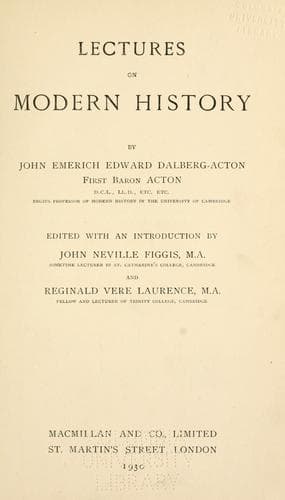
Lectures on Modern historyActon, John Emerich Edward Dalberg Acton, Baron
History
Lectures on Modern history
Acton, John Emerich Edward Dalberg Acton, Baron
History, Modern
The constant lesson of the Revolution was that England preferred
monarchy. But after the fall of Walpole it was observed that there was
a new growth of republican sentiment, and that the country felt itself
superior to the government. This was the natural result of the time
known as the Robinocracy; not because he devised liberal measures, but
because he was careful to be neither wiser nor more liberal than the
public. He was quite content to preserve the government of the country
by the rich, in the interest of their own class. Unlike Stanhope, his
predecessor, he was unmoved by the intolerance of the laws in England,
and especially in Ireland. He was a friend to Free Trade; but he
suffered Ireland to be elaborately impoverished, for the benefit of
English landlords. Slavery and the slave trade, which Bolingbroke had
promoted, were not remedied or checked by this powerful Whig. The
criminal Code, in his time, grew annually more severe; and I need
enter into no details as to the treatment of the prisoners and of the
poor. Walpole was so powerful, and was powerful so long, that much of
the responsibility for all these things is at his door. On this
account, and not because he governed by patronage and pensions and
ribbons and bribes, he was a false Whig.
Government by Party was established in 1714, by Party acting through
the Cabinet. Walpole added to this the prime minister, the accepted
head of the Party and of the Cabinet. As the king did not preside,
the minister who did preside discharged many functions of the king.
The power of governing the country was practically transferred. It
was shared, not between the minister and the king, but between the
head of the ministry and the head of the opposition. For Party
implies the existence of a party which is out as well as a party that
is in. There is a potential ministry ready for office whenever the
majority is shifted. As Walpole remained twenty-one years in office,
he ignored this part of the constitutional system. He never became a
leader of opposition, and when he resigned, no such thing had been
provided. "All the talents" were opposed to him, but they were not an
organised opposition. They were discontented and offended Whigs,
assailing ministers on no ground of principle. This form of
opposition was instituted by Pulteney, when he quarrelled with
Walpole. Pulteney founded the Craftsman, in which there was much good
political writing. For Bolingbroke had returned to England, and as he
was not allowed to resume his seat in the Lords, he could make his
power felt only through his pen. As he was thoroughly cured of his
Jacobite sympathies, the doctrine he proclaimed was a Toryism stripped
of the reactionary element. He proposed to make the State dominate
over all the interests--land, Church, trade, and the like. That this
might be done, and the government by a class for a class abolished, he
appealed to the crown. The elevation of the State over the dominant
Public-domain text, read in full here on John Shaqi.
Reviews
Reviews
No reviews yet
Be the first to share your thoughts on this work.
Elsewhere in the archive
Join the Discussion
Join the discussion
Sign in to leave a comment or review.
Sign InorCreate an account