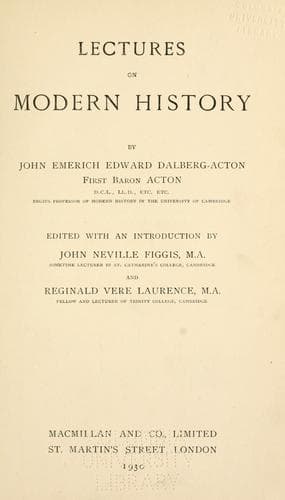
Lectures on Modern historyActon, John Emerich Edward Dalberg Acton, Baron
History
Lectures on Modern history
Acton, John Emerich Edward Dalberg Acton, Baron
History, Modern
classes had been the part of intelligent Monarchy in every age. And
it is the spell by which Bolingbroke transformed Toryism and
introduced the party called the King's Friends, which became a power
in the middle of the century, and was put an end to by Mr. Pitt,
after losing America, and setting up an English rival to England.
After the final fall of the Stuarts in 1746, this was the moving force
of Toryism, and the illiberal spirit was seriously curbed. Macaulay
goes so far as to say that the Tories became more liberal than the
Whigs. But it was an academic and Platonic liberality that did not
strengthen the constitution.
The Whigs, having added the unwritten clauses, exclusive government by
party, cabinet instead of council, and premier instead of king, did
nothing to discover defects to be reformed and principles to be
developed. They became Conservatives, satisfied with defending the
new dynasty and the institutions that accompanied it. One supreme
change was absolutely essential to complete their system. For its
essence was that the object of the law, which was liberty, should
prevail over the letter of the law, which was restraint. It required
that public opinion should control legislation. That could not be
done without the liberty of the press; and the press was not free
while it was forbidden to publish and to discuss the debates of
parliament. That prohibition was strictly maintained. For near
thirty years we know the debates, and even the divisions, chiefly
through the reports of Bonnet the Brandenburg resident, and of
Hoffmann the Austrian resident, who tell us much that is sought vainly
in the meagre pages of Hansard. Then came the epoch of Dr. Johnson
and his colleagues in Grub Street. But when the Whig reign ended, at
the resignation of the great Commoner in 1761, the Whigs had not
admitted the nation to the parliamentary debates.
The debates were made public in 1774. The unreported parliament of
1768, as it is called, is the first that was properly reported. The
speeches were taken down by one of the members, Cavendish, the
ancestor of the Waterparks. A portion has been printed and forgotten.
The remainder is preserved in manuscript, and contains, in all, about
two hundred and fifty speeches of Edmund Burke. It is of no little
value to political students, inasmuch as Burke at his best is England
at its best. Through him and through American influence upon him, the
sordid policy of the Walpolean Whigs became a philosophy, and a
combination of expedients was changed into a system of general
principles.
XVII
PETER THE GREAT AND THE RISE OF PRUSSIA
WHILST THE English people, with the example and assistance of the
Dutch, were carrying forward the theory of constitutional government,
a still more important movement in the opposite direction was
proceeding in the North, and new forces were brought into the widening
circle of general history.
Public-domain text, read in full here on John Shaqi.
Reviews
Reviews
No reviews yet
Be the first to share your thoughts on this work.
Elsewhere in the archive
Join the Discussion
Join the discussion
Sign in to leave a comment or review.
Sign InorCreate an account