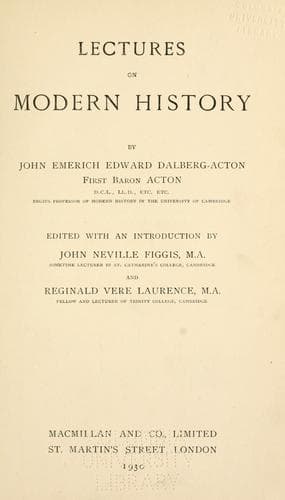
Lectures on Modern historyActon, John Emerich Edward Dalberg Acton, Baron
History
Lectures on Modern history
Acton, John Emerich Edward Dalberg Acton, Baron
History, Modern
The second king succeeded in 1713 and died in 1740. He is the Peter
the Great of Prussia. For him, the whole secret of government is the
increase of power at home. His idea was that monarchy cannot be too
absolute. It requires to be wisely administered; but it does not
require to be limited. Concentration cannot be too intense. No enemy
outside is so dangerous as public opinion within. He announced that
he would establish his power on a rock--"un rocher de bronze." He meant
that the power of the State must be independent of the changing
motives of the hour, that it must be directed by a will superior alike
to majority and minority, to interests and classes. He spent his
reign in very deliberately contriving such a machine. The king, he
said, must do his work himself, and not shrink from trouble. He was
perpetually in harness. He was like a madman in his vehemence and his
crudity of speech. But there was method in his fury, and calculating
design and even practical wisdom. He gave an impetus as powerful as
that of the Tsar Peter; but he was superior to him in knowledge of
detail as well as in point of character. He was a hard taskmaster,
but he knew what he was about; and it does not appear that his
subjects desired to be governed in another way or that they would have
been satisfied with a monarch who did not strain their strength to the
uttermost.
The object in which they agreed with him--the supremacy of the
Prussians in Germany--was not to be obtained if they would not go into
training. There was no shrinking. He said, in 1713: "when my son
comes to the throne he must find the vaults crowded with gold," and
the son, in 1740, found eight million thalers. He found, moreover, a
well-equipped army of eighty-three thousand men. This was the special
creation of the energetic king. He was, indeed, a peaceful ruler, and
did not thirst for military glory. Among European Powers he was of
little account, and kept all his violence for home use. When he laid
up treasure, and organised an army that was not so large as that of
France, of Austria, or of Russia, but more concentrated and better
drilled, his people understood that he would some day provide
territory and population to match--an army so excessive, an army six
times as large, in proportion to those of other Powers, was meant to
be employed. The burden was not felt. Of the expense, one-half was
borne by the domain. Of the men, a large portion was recruited abroad,
and relieved the natives of Prussia. After some years, it was felt
that the platoons of giants, which had cost twelve million thalers,
were a wasteful toy, and that the money might have been spent to
advantage among the people. The king attempted to supply their place
by a levy among the the agrarian population, which is reputed the
remote origin of universal service. His economy was so rigid that,
with an income of seven million thalers, he spent five millions on his
armaments.
Public-domain text, read in full here on John Shaqi.
Reviews
Reviews
No reviews yet
Be the first to share your thoughts on this work.
Elsewhere in the archive
Join the Discussion
Join the discussion
Sign in to leave a comment or review.
Sign InorCreate an account