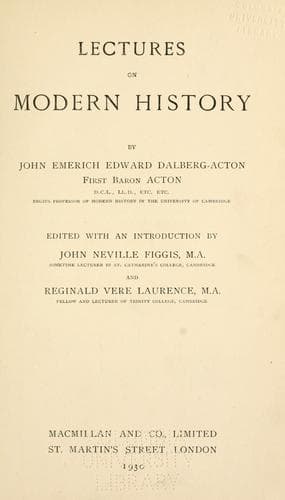
Lectures on Modern historyActon, John Emerich Edward Dalberg Acton, Baron
History
Lectures on Modern history
Acton, John Emerich Edward Dalberg Acton, Baron
History, Modern
It was evident from the first that the combination was more than
England could hope to meet. Lord North at once gave way. He offered
to satisfy the American demands, and he asked that Chatham should take
office. From the moment that his old enemy, France, appeared on the
scene, Chatham was passionately warlike. The king agreed that he
should be asked to join the ministry, but refused to see him. America
declined the English overtures, in fulfilment of her treaty with
France. The negotiation with Chatham became impossible. That was no
misfortune, for he died a few weeks later, denouncing the government
and the opposition.
Then came that phase of war during which the navy of France, under
d'Orvilliers in the Channel, under Suffren in the east, under
d'Estaing and de Grasse in the west, proved itself equal to the navy
of England. It was by the fleet, not by the land forces, that
American independence was gained. But it was by the army officers
that American ideas, sufficient to subvert every European state, were
transplanted into France. When de Grasse drove the English fleet away
from Virginian waters, Cornwallis surrendered the army of the south at
Yorktown, as Burgoyne had surrendered with the northern army at
Saratoga.
The Whigs came in and recognised the independence of the colonies, as
North would have done four years earlier, when France intervened.
Terms of peace with European Powers were made more favourable by the
final success of Rodney at Dominica and of Elliot at Gibraltar; but
the warlike repute of England fell lower than at any time since the
Revolution.
The Americans proceeded to give themselves a Constitution which should
hold them together more effectively than the Congress which carried
them through the war, and they held a Convention for the purpose at
Philadelphia during the summer of 1787. The difficulty was to find
terms of union between the three great states--Virginia, Pennsylvania,
Massachusetts--and the smaller ones, which included New York. The great
states would not allow equal power to the others; the small ones would
not allow themselves to be swamped by mere numbers. Therefore one
chamber was given to population, and the other, the Senate, to the
states on equal terms. Every citizen was made subject to the federal
government as well as to that of his own state. The powers of the
states were limited. The powers of the federal government were
actually enumerated, and thus the states and the union were a check on
each other. That principle of division was the most efficacious
restraint on democracy that has been devised; for the temper of the
Constitutional Convention was as conservative as the Declaration of
Independence was revolutionary.
Public-domain text, read in full here on John Shaqi.
Reviews
Reviews
No reviews yet
Be the first to share your thoughts on this work.
Elsewhere in the archive
Join the Discussion
Join the discussion
Sign in to leave a comment or review.
Sign InorCreate an account