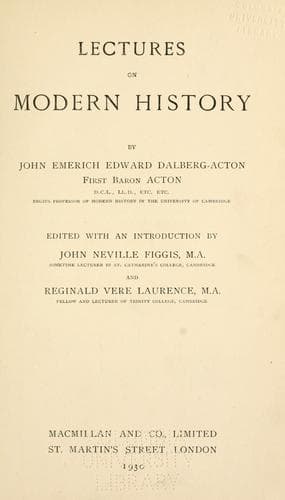
Lectures on Modern historyActon, John Emerich Edward Dalberg Acton, Baron
History
Lectures on Modern history
Acton, John Emerich Edward Dalberg Acton, Baron
History, Modern
The first of human concerns is religion, and it is the salient
feature of the modern centuries. They are signalised as the
scene of Protestant developments. Starting from a time of
extreme indifference, ignorance, and decline, they were at once
occupied with that conflict which was to rage so long, and of
which no man could imagine the infinite consequences. Dogmatic
conviction--for I shun to speak of faith in connection with many
characters of those days--dogmatic conviction rose to be the
centre of universal interest, and remained down to Cromwell the
supreme influence and motive of public policy. A time came when
the intensity of prolonged conflict, when even the energy of
antagonistic assurance abated somewhat, and the controversial
spirit began to make room for the scientific; and as the storm
subsided, and the area of settled questions emerged, much of the
dispute was abandoned to the serene and soothing touch of
historians, invested as they are with the prerogative of
redeeming the cause of religion from many unjust reproaches, and
from the graver evils of reproaches that are just. Ranke used to
say that Church interests prevailed in politics until the Seven
Years' War, and marked a phase of society that ended when the
hosts of Brandenburg went into action at Leuthen, chaunting their
Lutheran hymns #29. That bold proposition would be disputed even if
applied to the present age. After Sir Robert Peel had broken up
his party, the leaders who followed him declared that no popery
was the only basis on which it could be reconstructed #30. On the
other side may be urged that, in July 1870, at the outbreak of
the French war, the only government that insisted on the
abolition of the temporal power was Austria; and since then we
have witnessed the fall of Castelar, because he attempted to
reconcile Spain with Rome.
Soon after 1850 several of the most intelligent men in France,
struck by the arrested increase of their own population and by
the telling statistics from Further Britain, foretold the coming
preponderance of the English race. They did not foretell, what
none could then foresee, the still more sudden growth of Prussia,
or that the three most important countries of the globe would, by
the end of the century, be those that chiefly belonged to the
conquests of the Reformation. So that in Religion, as in so many
things, the product of these centuries has favoured the new
elements; and the centre of gravity, moving from the Mediterranean
nations to the Oceanic, from the Latin to the Teuton, has also
passed from the Catholic to the Protestant #31.
Public-domain text, read in full here on John Shaqi.
Reviews
Reviews
No reviews yet
Be the first to share your thoughts on this work.
Join the Discussion
Join the discussion
Sign in to leave a comment or review.
Sign InorCreate an account