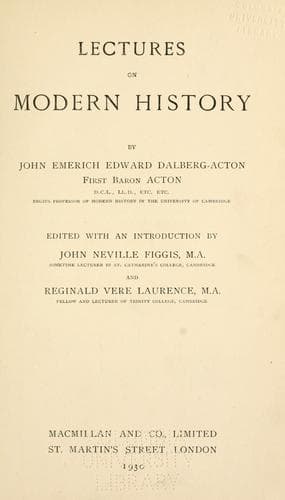
Lectures on Modern historyActon, John Emerich Edward Dalberg Acton, Baron
History
Lectures on Modern history
Acton, John Emerich Edward Dalberg Acton, Baron
History, Modern
In this way Charles was compelled to turn his arms against Rome. He
protested that he would risk all his crowns for the sake of revenge,
and appealed to Germany, with its Lutherans, for support. Tell them,
he wrote, that they are wanted against the Turk. They will know what
Turk we mean. They knew it so well that the landsknechts came
provided with silken nooses for the necks of cardinals, besides a
gold-thread one for the Pope. He issued a detailed manifesto against
him, the work of Valdes, one of the rare Lutherans of Spain; and those
who were in the secret expected that the shrift would be short.
Francis had intended from the first moment to break his word, and to
execute no conditions injurious to France, but he came too late. A
large body of Germans poured over the Alps and joined the Spaniards in
Lombardy. It was observed afterwards that the Spaniards were the most
vindictive, but it was the Germans who made the push for Rome; and
Bourbon, on the plea of economy, as he could not pay them, led them
through the passes of the Apennines, overthrowing the Medici at
Florence on the way. Rome was taken almost without resistance, and
Clement shut himself up in St. Angelo, while the city was given over
to unmerciful pillage, the prelates were held to ransom, and all the
secret treasure was got at by torture. That month of May 1527, with
its awful experience, was an end to the pride and the hope and the
gladness of the pagan revival; a severe and penitential spirit came
over society, preparing to meet the Reformation by reform, and to
avert change in doctrine by a change in morality. The sack of Rome,
said Cardinal Cajetan, was a just judgment on the sufferers. The city
was now the Emperor's, by right of conquest, to bestow as he chose,
and the Romans were not unwilling that it should be his capital. Some
said that the abolition of the temporal power would secure peace among
the Powers, whilst others thought that the consequence would be a
patriarch in France, if not in England as well. The last effort of
the French being spent, and Doria having gone over to the Emperor,
taking with him Genoa, the key of French influence, the chain of
transactions which began with the Neapolitan expedition of 1494,
concluded in 1530 with the siege of Florence. Charles made peace with
France at Cambray, and with the Pope at Barcelona, and received the
imperial crown at Bologna.
Public-domain text, read in full here on John Shaqi.
Reviews
Reviews
No reviews yet
Be the first to share your thoughts on this work.
Elsewhere in the archive
Join the Discussion
Join the discussion
Sign in to leave a comment or review.
Sign InorCreate an account