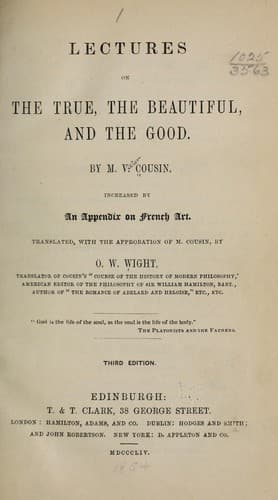
Lectures on the true, the beautiful and the goodCousin, Victor
Philosophy
Lectures on the true, the beautiful and the good
Cousin, Victor
Aesthetics; Ethics; Truth
You see what is the extent of imagination: it has no limits, it is
applied to all things. Its distinctive character is that of deeply
moving the soul in the presence of a beautiful object, or by its
remembrance alone, or even by the idea alone of an imaginary object. It
is recognized by the sign that it produces, by the aid of its
representations, the same impression as, and even an impression more
vivid than, nature by the aid of real objects. If beauty, absent and
dreamed of, does not affect you as much as, and more than, present
beauty, you may have a thousand other gifts,--that of imagination has
been refused you.
In the eyes of imagination, the real world languishes in comparison with
its own fictions. One may feel that imagination is his master by the
_ennui_ that real and present things give him. The phantoms of imagination
have a vagueness, an indefiniteness of form, which moves a thousand
times more than the clearness and distinctness of actual perceptions.
And then, unless we are wholly mad,--and passion does not always render
this service,--it is very difficult to see reality otherwise than as it
is not, that is to say, very imperfectly. On the other hand, one makes
of an image what he wishes, unconsciously metamorphoses it, embellishes
it to his own liking. There is at the bottom of the human soul an
infinite power of feeling and loving to which the entire world does not
answer, still less a single one of its creatures, however charming. All
mortal beauty, viewed near by, does not suffice for this insatiable
power which it excites and cannot satisfy. But from afar, its effects
disappear or are diminished, shades are mingled and confounded in the
clear-obscure of memory and dream, and the objects please more because
they are less determinate. The peculiarity of men of imagination is,
that they represent men and things otherwise than as they are, and that
they have a passion for such fantastic images. Those that are called
positive men, are men without imagination, who perceive only what they
see, and deal with reality as it is instead of transforming it. They
have, in general, more reason than sentiment; they may be seriously,
profoundly honest; they will never be either poets or artists. What
makes the poet or artist is, with a foundation of good sense and
reason--without which all the rest is useless--a sensitive, even a
passionate heart; above all, a vivid, a powerful imagination.
If sentiment acts upon imagination, we see that imagination returns with
usury to sentiment what it gives.
Public-domain text, read in full here on John Shaqi.
Reviews
Reviews
No reviews yet
Be the first to share your thoughts on this work.
Elsewhere in the archive
Join the Discussion
Join the discussion
Sign in to leave a comment or review.
Sign InorCreate an account