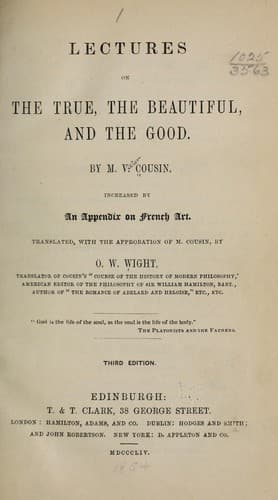
Lectures on the true, the beautiful and the goodCousin, Victor
Philosophy
Lectures on the true, the beautiful and the good
Cousin, Victor
Aesthetics; Ethics; Truth
This pure and ardent passion, this worship of beauty that makes the
great artist, can be found only in a man of imagination. In fact, the
sentiment of the beautiful may be awakened in each one of us before any
beautiful object; but, when this object has disappeared, if its image
does not subsist vivaciously retraced, the sentiment which it for a
moment excited is little by little effaced; it may be revived at the
sight of another object, but only to be extinguished again,--always
dying to be born again at hazard; not being nourished, increased,
exalted by the vivacious and continuous reproduction of its object in
the imagination, it wants that inspiring power, without which there is
no artist, no poet.
A word more on another faculty, which is not a simple faculty, but a
happy combination of those which have just been mentioned,--taste, so
ill treated, so arbitrarily limited in all theories.
If, after having heard a beautiful poetical or musical work, admired a
statue or a picture, you are able to recall what your senses have
perceived, to see again the absent picture, to hear again the sounds
that no longer exist; in a word, if you have imagination, you possess
one of the conditions without which there is no true taste. In fact, in
order to relish the works of imagination, is it not necessary to have
taste? Do we not need, in order to feel an author, not to equal him,
without doubt, but to resemble him in some degree? Will not a man of
sensible, but dry and austere mind, like Le Batteux or Condillac, be
insensible to the happy darings of genius, and will he not carry into
criticism a narrow severity, a reason very little reasonable--since he
does not comprehend all the parts of human nature,--an intolerance that
mutilates and blemishes art while thinking to purify it?
On the other hand, imagination does not suffice for the appreciation of
beauty. Moreover, that vivacity of imagination so precious to taste,
when it is somewhat restrained, produces, when it rules, only a very
imperfect taste, which, not having reason for a basis, carelessly
judges, runs the risk of misunderstanding the greatest beauty,--beauty
that is regulated. Unity in composition, harmony of all the parts, just
proportion of details, skilful combination of effects, discrimination,
sobriety, measure, are so many merits it will little feel, and will not
put in their place. Imagination has doubtless much to do with works of
art; but, in fine, it is not every thing. Is it only imagination that
makes the _Polyeucte_ and the _Misanthrope_, two incomparable marvels?
Is there not, also, in the profound simplicity of plan, in the measured
development of action, in the sustained truth of characters, a superior
reason, different from imagination which furnishes the superior colors,
and from sensibility that gives the passion?
Public-domain text, read in full here on John Shaqi.
Reviews
Reviews
No reviews yet
Be the first to share your thoughts on this work.
Elsewhere in the archive
Join the Discussion
Join the discussion
Sign in to leave a comment or review.
Sign InorCreate an account