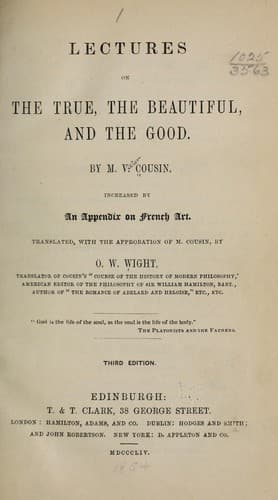
Lectures on the true, the beautiful and the goodCousin, Victor
Philosophy
Lectures on the true, the beautiful and the good
Cousin, Victor
Aesthetics; Ethics; Truth
Besides imagination and reason, the man of taste ought to possess an
enlightened but ardent love of beauty; he must take delight in meeting
it, must search for it, must summon it. To comprehend and demonstrate
that a thing is not beautiful, is an ordinary pleasure, an ungrateful
task; but to discern a beautiful thing, to be penetrated with its
beauty, to make it evident, and make others participate in our
sentiment, is an exquisite joy, a generous task. Admiration is, for him
who feels it, at once a happiness and an honor. It is a happiness to
feel deeply what is beautiful; it is an honor to know how to recognize
it. Admiration is the sign of an elevated reason served by a noble
heart. It is above a small criticism, that is skeptical and powerless;
but it is the soul of a large criticism, a criticism that is productive:
it is, thus to speak, the divine part of taste.
After having spoken of taste which appreciates beauty, shall we say
nothing of genius which makes it live again? Genius is nothing else than
taste in action, that is to say, the three powers of taste carried to
their culmination, and armed with a new and mysterious power, the power
of execution. But we are already entering upon the domain of art. Let us
wait, we shall soon find art again and the genius that accompanies it.
FOOTNOTES:
[96] Except the estimable _Essay on the Beautiful_, by P. Andre, a
disciple of Malebranche, whose life was considerably prolonged into the
eighteenth century. On P. Andre, see 3d Series, vol. iii., _Modern
Philosophy_, p. 207, 516.
[97] See in the works of Diderot, _Pensees sur la Sculpture, les
Salons_, etc.
[98] See 1st Series, vol. iv., explained and estimated, the theories of
Hutcheson and Reid.
[99] The theory of Kant is found in the _Critique of Judgment_, and in
the _Observations_ on the _Sentiment of the Beautiful and the Sublime_.
See the excellent translation made by M. Barny, 2 vols., 1846.
[100] On Hutcheson and Smith, their merits and defects, the part of
truth and the part of error, which their philosophy contains, see the
detailed lectures which we have devoted to them, 1st Series, vol. iv.
[101] See the exposition and refutation of the doctrine of Condillac and
Helvetius, _Ibid._, vol. iii.
[102] See lecture 5, in this vol.
LECTURE VII.
THE BEAUTIFUL IN OBJECTS.
Refutation of different theories on the nature of the beautiful:
the beautiful cannot be reduced to what is useful.--Nor to
convenience.--Nor to proportion.--Essential characters of the
beautiful.--Different kinds of beauties. The beautiful and the
sublime. Physical beauty. Intellectual beauty. Moral
beauty.--Ideal beauty: it is especially moral beauty.--God, the
first principle of the beautiful.--Theory of Plato.
Public-domain text, read in full here on John Shaqi.
Reviews
Reviews
No reviews yet
Be the first to share your thoughts on this work.
Elsewhere in the archive
Join the Discussion
Join the discussion
Sign in to leave a comment or review.
Sign InorCreate an account